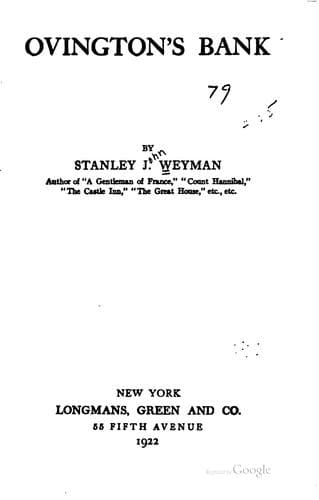
Banks and banking -- Fiction; England -- Social life and customs -- 19th century -- Fiction; Love stories
The delay was very bitter to him. He had ridden out determined to put
his fate to the test, to let nothing stand between him and his love, to
over-ride excuses; and he could not in a moment make up his mind to be
thwarted.
“And I must wait? I must go on waiting? Eating my heart out—doing
nothing?”
“There is no other way. Indeed, indeed there is not.”
“But it is too much. It is too much, Jos, that you ask!”
“Then, Clement——”
“Well?”
“You must give me up.” She spoke firmly but her lips quivered, and
there were tears in her eyes.
He was silent. At last, “Do you wish me to do that?” he said.
She looked at him for answer, and his doubts, if he had doubted her,
his distrust, if it had been possible for him to distrust her,
vanished. His heart melted. They were a very simple pair of lovers,
moved by simple impulses.
“Forgive me, oh, forgive me, dear!” he cried. “But mine is a hard task,
a hard task. You do not know what it is to wait, to wait and to do
nothing!”
“Do I not?” Her eyes were swimming. “Is it not that which I am doing
every day, Clem? But I have faith in you, and I believe in you. I
believe that all will come right in the end. If you trust me, as I
trust you, and have to trust you——”
“I will, I will,” he cried, repentant, remorseful, recognizing in her a
new decision, a new sweetheart, and doing homage to the strength that
trial and suffering had given her. “I will trust you, trust you—and
wait!”
Her eyes thanked him, and her hands; and after this there was little
more to be said. She was anxious that he should go, and they parted. He
rode back to Aldersbury, thinking less of himself and more of her, and
something too of the old man, who, blind and shorn of his strength, had
now to lean on women, and suspicious by habit must now trust others,
whether he would or no. Clement had imagination, and by its light he
saw the pathos of the Squire’s position; of his helplessness in the
midst of the great possessions he had gathered, and the acres that he
had added, acre to acre. He who had loved to look on hill and covert
and know them his own, to whom every copse and hedgerow was a friend,
who had watched his marches so jealously and known the rotation of
every field, must now fume and fret, thinking them neglected,
suspecting waste, doubting everyone, lacking but a little of doubting
even his daughter.
“Poor chap!” he muttered, “poor old chap!” He was sorry for the Squire,
but he was even more sorry for himself. Any other, he felt, would have
surmounted the obstacles that stopped him, or by one road or another
would have gone round them. But he was no good, he was useless. Even
his sweetheart—this in a little spirit of bitterness—took the upper
hand and guided him and imposed her will on him. He was nothing.
Public-domain text, read in full here on John Shaqi.
Reviews
Reviews
No reviews yet
Be the first to share your thoughts on this work.
Elsewhere in the archive
Join the Discussion
Join the discussion
Sign in to leave a comment or review.
Sign InorCreate an account