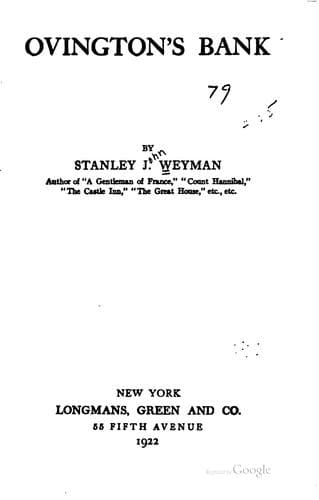
Banks and banking -- Fiction; England -- Social life and customs -- 19th century -- Fiction; Love stories
In the bank he grew more taciturn, doing his business with less spirit
than before, suspecting Arthur and avoiding speech with him, meeting
his careless smile with a stolid face. His father, Rodd too, deemed him
jealous of the new partner, and his father, growing in these days a
little sharp in temper, spoke to him about it.
“You took no interest in the business,” he said, “and I had to find
some one who would take an interest and be of use to me. Now you are
making difficulties and causing unpleasantness. You are behaving ill,
Clement.”
But Clement only shrugged his shoulders. He had become indifferent. He
had his own burden to bear.
CHAPTER XXII
Arthur, on the other hand, felt that things were going well with him. A
few months earlier he had decided that a partnership in Ovington’s
would be cheaply bought at the cost of a rupture with his uncle. Now he
had the partnership, he could look forward to the wealth and importance
which it would bring—and he had not to pay the price. On the contrary,
his views now took in all that he had been prepared to resign, as well
as all that he had hoped to gain. They took in Garth, and he saw
himself figuring not only as the financier whose operations covered
many fields, and whose riches were ever increasing, but as the landed
Squire, the man of family, whose birth and acres must give him a
position in society which no mere wealth could confer. The unlucky
night which had cost the old man so much, had been for Arthur the
birth-night of fortune. He could date from it a favor, proof, as he now
believed, against chance and change, a favor upon which it seemed
unlikely that he could ever overdraw.
For since his easy victory on the question of the India Stock, he had
become convinced that the Squire was failing. The old man, once so
formidable, was changed; he had grown, if not weak, yet dependent. And
it could hardly be otherwise, Arthur reflected. The loss of sight was a
paralyzing deprivation, and it had fallen on the owner of Garth at a
time of life when any shock must sap the strength and lower the
vitality. For a while his will had reacted, he had seemed to bear up
against the blow, but age will be served, and of late he had grown more
silent and apathetic. Arthur had read the signs and drawn the
conclusion, and was now sure that, blind and shaken, the old man would
never again be the man he had been, or assert himself against an
influence which a subtler brain would know how to weave about him.
Public-domain text, read in full here on John Shaqi.
Reviews
Reviews
No reviews yet
Be the first to share your thoughts on this work.
Elsewhere in the archive
Join the Discussion
Join the discussion
Sign in to leave a comment or review.
Sign InorCreate an account