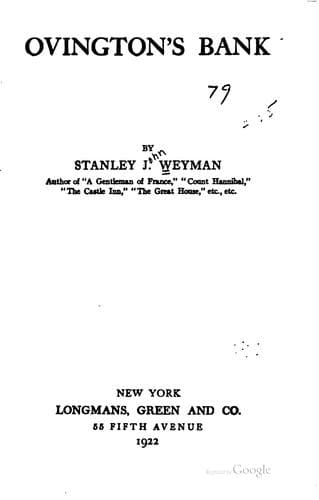
Banks and banking -- Fiction; England -- Social life and customs -- 19th century -- Fiction; Love stories
Arthur was thinking of this as he rode into town one morning in
November, his back turned to the hills and the romance of them, his
face to the plain. It was early in the month. St. Luke’s summer,
prolonged that year, had come to an end a day or two before, and the
air was raw, the outlook sombre. Under a canopy of grey mist, the
thinning hedge-rows and dripping woods showed dark against clear blue
distances. But in the warmth of his thoughts the rider was proof
against weather, and when he came to the sedgy spot, never more dreary
to the view than to-day, which Thomas had chosen for his attack on the
Squire, he smiled. That little patch of ground had done much for him,
but at a price, of course—for there he had lost a friend, a good easy
friend in Clement. And Betty—Betty, whose coolness had caused him more
than one honest pang—he had no doubt that there had come a change in
her, too, from that date.
But one had to pay a price for everything, and these were but small
spots on the sun of his success. Soon he had put the thought of them
from him, and, abreast of the first houses of the town, began to employ
his mind on the work of the day—revolving this and that, matters
outside routine which would demand his attention. He knew what was
likely to arise.
Rarely in these days did he enter Aldersbury without a feeling of
elation. The very air of the town inspired him. The life of the
streets, the movement of the markets, the sight of the shopkeepers at
their doors, the stir and bustle had their appeal for him. He felt
himself on his own ground; it was here and not in the waste places that
his work lay, here that he was formed to conquer, here that he was
conquering fortune. Garth was very well—a grand, a splendid reserve;
but as he rode up the steep streets to the bank, he felt that here was
his vocation. He sniffed the battle, his eyes grew brighter, his figure
more alert. From some Huguenot ancestor had descended the Huguenot
appetite for business, the Huguenot ability to succeed.
This morning, however, he did not reach the bank in his happiest mood.
Purslow, the irrepressible Purslow, stopped him, with a long face and a
plaint to match. “Those Antwerp shares, Mr. Bourdillon! Excuse me, have
you heard? They’re down again—down twenty-five since Wednesday! And
that’s on to five, as they fell the week before! Thirty down, sir! I’m
in a regular stew about it! Excuse me, sir, but if they fall much
more——”
“You’ve held too long, Purslow,” Arthur replied. “I told you it was a
quick shot. A fortnight ago you’d have got out with a good profit. Why
didn’t you?”
“But they were rising—rising nicely. And I thought, sir——”
“You thought you’d hold them for a bit more? That was the long and
short of it, wasn’t it? Well, my advice to you now is to get out while
you can make a profit.”
“Sell?” the draper exclaimed. “Now?” It is hard to say what he had
expected, but something more than this. “But I should not clear more
than—why, I shouldn’t make——”
Public-domain text, read in full here on John Shaqi.
Reviews
Reviews
No reviews yet
Be the first to share your thoughts on this work.
Elsewhere in the archive
Join the Discussion
Join the discussion
Sign in to leave a comment or review.
Sign InorCreate an account