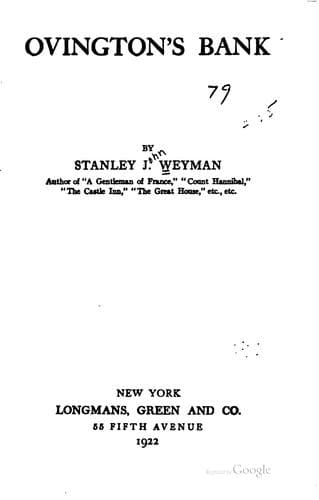
Banks and banking -- Fiction; England -- Social life and customs -- 19th century -- Fiction; Love stories
“But isn’t—isn’t all this a little premature?” Arthur asked, his tone
cold and business-like. “I don’t understand why you think that all this
is coming upon us at a moment’s notice, sir? Without warning?”
“Not quite without warning,” the banker rejoined with patience.
Clement’s declaration of faith had moved him more deeply than he
showed, and, having that, he could bear a little disappointment. “I
have hinted more than once, Arthur, that I was uneasy. But why, you
ask, this sudden alarm—now? Well, look at Richardson’s list of last
Friday’s prices. You have not seen it. Exchequer Bills that a week ago
were at par are at a discount. India Stock are down five points on the
day—a large fall for such a stock. New Four per Cents, have fallen 3,
Bank Stock that stood at 224 ten days ago is 214. These are not panic
falls, but they are serious figures. With Bank Stock falling ten points
in as many days, what will happen to the immense mass of speculative
securities held by the public, and on much of which calls are due? It
will be down this week; next week the banks will have to throw it out
to save their margins, and customers to pay their calls. It will fall,
and fall. The week after, perhaps, panic! A rush to draw deposits, or a
rush to cash notes, or, probably, both.”
“Then you think—you must think”—Arthur’s voice was not quite under his
control—“that there is danger?”
“It would be as foolish in me to deny it here,” the banker replied
gravely, “as it would be reckless in me to affirm it outside. There is
danger. We shall run a risk, but I believe that we shall win through,
though, it may be, by a narrow margin. And a little thing might upset
us.”
Arthur was not of an anxious temperament—far from it. But he had
committed himself to the bank. He had involved himself in its fortunes
in no ordinary way. He had joined it against the wishes of his friends
and in the teeth of the prejudices of his caste. He had staked his
reputation for judgment upon its success, and assured that it would
give him in the future all for which he thirsted, he had deemed himself
far-sighted, and others fools. In doing this he had never dreamt of
failure, he had never weighed the possibility of loss. Not once had he
reflected that he might turn out to be wrong and robbed of the
prize—might in the end be a laughing-stock!
Now as the possibility of all this, as the thought of failure, complete
and final, flooded his mind and shook his self-confidence, he flinched.
Danger! Danger, owned to by Ovington himself! Ah, he ought to have
known! He ought to have suspected that fortunes were not so easily
made! He ought to have reflected that Ovington’s was not Dean’s! That
it was but a young bank, ill-rooted as yet—and speculative! Ay,
speculative! Such a bank might fall, he was almost certain now that it
would fall, as easily as it had risen!
Public-domain text, read in full here on John Shaqi.
Reviews
Reviews
No reviews yet
Be the first to share your thoughts on this work.
Elsewhere in the archive
Join the Discussion
Join the discussion
Sign in to leave a comment or review.
Sign InorCreate an account