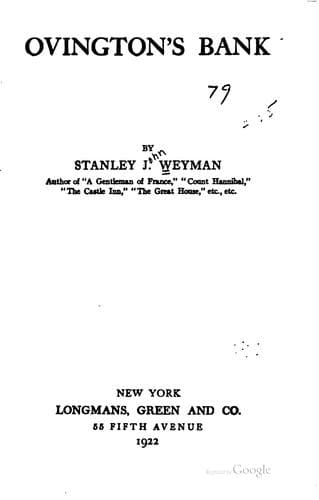
Banks and banking -- Fiction; England -- Social life and customs -- 19th century -- Fiction; Love stories
It was a nerve-shaking vision that rose before him, and for a moment he
could not hide his disorder. At any rate, he could not hide it from two
jealous eyes. Clement saw and condemned—not fully understanding all
that this meant to the other or the sudden strain which it put upon
him. A moment and Arthur was himself again, and his first words
recovered for him the elder man’s confidence. They were practical.
“How much—I mean, what extra amount of reserve,” he asked, “would make
us safe?”
“Just so,” and in the banker’s eyes there shone a gleam of relief.
“Well, if we had twelve thousand pounds, in addition to our existing
assets, I think—nay, I am confident that that would place us out of
danger.”
“Twelve thousand pounds.”
“Yes. It is not a large sum. But it might make all the difference if it
came to a pinch.”
“In cash?”
“In gold, or Bank paper. Or in such securities as could be realized
even in a crisis. Twelve thousand added to our reserve—I think I may
say with confidence that with that we could meet any run that could be
made upon us.”
“There is no doubt that we are solvent, sir?”
“You should know that as well as I do.”
“We could realize the twelve thousand eventually?”
“Of course, or we should not be solvent without it.” For once Ovington
spoke a little impatiently.
“Then could we not,” Arthur asked, “by laying our accounts before our
London agents obtain the necessary help, sir?”
“If we were the only bank likely to be in peril, of course we could.
And even as it is, you are so far right that I had already determined
to do that. It is the obvious course, and my bag is being packed in the
house—I shall go to town by the afternoon coach. And now,” rising to
his feet, “we have been together long enough—we must be careful to
cause no suspicion. Do you, Clement, see Massy, the wine-merchant
to-day, and tell him that I will take, to lay down, the ten dozen of
’20 port that he offered me. And ask the two Welshes to dine with me on
Friday—I shall return on Thursday. And get some oysters from
Hamar’s—two barrels—and have one or two people to dine while I am away.
And, cheerful faces, boys—and still tongues. And now go. I must put
into shape the accounts that I shall need in town.”
He dismissed them with calmness, but he did not at once fall to work
upon the papers. His serenity was that of the commander who, on the eve
of battle, reviews the issues of the morrow, and habituated to the
chances of war, knows that he may be defeated, but makes his
dispositions, folds his cloak about him, and lies down to sleep. But
under the cloak of the commander, and behind the mask that deceives
those about him, is still the man, with the man’s hopes and fears, and
cares and anxieties, which habit has rendered tolerable, and pride
enables him to veil. But they are there. They are there.
Public-domain text, read in full here on John Shaqi.
Reviews
Reviews
No reviews yet
Be the first to share your thoughts on this work.
Elsewhere in the archive
Join the Discussion
Join the discussion
Sign in to leave a comment or review.
Sign InorCreate an account