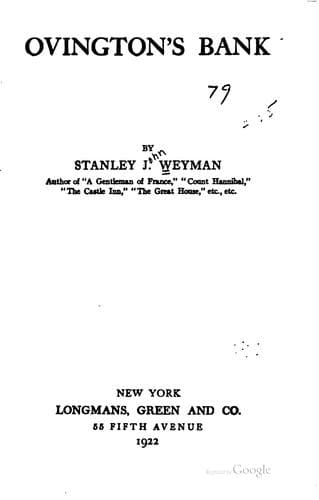
Banks and banking -- Fiction; England -- Social life and customs -- 19th century -- Fiction; Love stories
For a time indeed there was no public outcry and no great excitement on
the surface. For a time men kept their troubles to themselves, jealous
lest they should get abroad, and few suspected how common was their
plight or how many shared it. Men talk of their gains but not of their
losses, and the last thing desired by a business man on the brink of
ruin is that his position should be made public. But those behind the
scenes feared only the more for the morrow; for with this ferment of
fear and suspense working beneath the surface it was impossible to say
at what moment an eruption might not take place or where the ruin would
stop. One thing was certain, that it would not be confined to the
speculators, for many a sober trader, who had never bought shares in
his life, would fail, beggared by the bankruptcy of his debtors.
Ovington returned on the Friday, and Arthur met him at the Lion, as he
had met him eleven months before. They played their parts well—so well
that even Arthur did not learn the news until the door of the bank had
closed behind them and they were closeted with Clement in the
dining-room. Then they learned that the news was bad—as bad as it could
be.
The banker retained his composure and told his story with calmness, but
he looked very weary. Williams’—Williams and Co. were Ovington’s
correspondents in London—would do nothing, he told them. “They would
not re-discount a single bill nor hear of an acceptance. My own opinion
is that they cannot.”
Arthur looked much disturbed. “As bad as that,” he said, “is it?”
“Yes, and I believe, nay, I am sure, lad, that they fear for
themselves. I saw the younger Williams. He gave me good words, but that
was all; and he looked ill and harassed to the last degree. There was a
frightened look about them all. I told them that if they would
re-discount fifteen thousand pounds of sound short bills, we should
need no further help, and might by and by be able to help others. But
he would do nothing. I said I should go to the Bank. He let out—though
he was very close—that others had done so, and that the Bank would do
nothing. He hinted that they were short of gold there, and saw nothing
for it but a policy of restriction. However, I went there, of course.
They were very civil, but they told me frankly that it was impossible
to help all who came to them; that they must protect their reserve.
They were inclined to find fault, and said it was credit recklessly
granted that had produced the trouble, and the only cure was
restriction.”
“But surely,” Arthur protested, “where a bank is able to show that it
is solvent?”
Public-domain text, read in full here on John Shaqi.
Reviews
Reviews
No reviews yet
Be the first to share your thoughts on this work.
Elsewhere in the archive
Join the Discussion
Join the discussion
Sign in to leave a comment or review.
Sign InorCreate an account