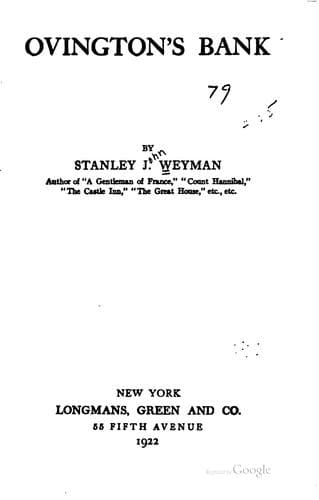
Banks and banking -- Fiction; England -- Social life and customs -- 19th century -- Fiction; Love stories
Worse, and far more important, than this matter was the fact that
stocks and shares continued to fall all that week. Night after night
the arrival of the famous “Wonder,” the fast coach which did the
journey from London in fifteen hours, was awaited by men who thought
nothing of the wintry weather if they might have the latest news.
Afternoon after afternoon the journals brought by the mail were fought
for and opened in the street by men whose faces grew longer as the week
ran on. Some strode up jauntily, and joined themselves to the group of
loungers before the coach-office, while others sneaked up privily, went
no farther than the fringe of the crowd, and there, gravitating
together by twos and threes, conferred in low voices over prices and
changes. Some, until the coach arrived, lurked in a neighboring
churchyard, raised above the street, and glancing suspiciously at one
another affected to be immersed in the study of crumbling gravestones;
while a few made a pretence of being surprised, as they passed, by the
arrival of the mail, or hiding themselves in doorways appeared only at
the last moment, and when they believed that they might do so
unobserved.
One thing was noticeable of nearly all these; that they avoided one
another’s eyes, as if, declining to observe others, they became
themselves unseen. Once possessed of the paper they behaved in
different ways, according as they were of a sanguine or despondent
nature. Some tore the sheet open at once, devoured a particular column
and stamped or swore, or sometimes flung the paper underfoot. Others
sneaked off to the churchyard or to some neighboring nook, and there,
unable to wait longer, opened the journal with shaking fingers; while a
few—and these perhaps had the most at stake—dared not trust themselves
to learn the news where they might by any chance be overlooked, but
hurried homewards through “shuts” and by-lanes, and locked themselves
in their offices, afraid to let even their wives come near them.
For the news was very serious to very many; the more so as,
inexperienced in speculation, they clung for the most part to the hope
of a recovery, and could not bring themselves to sell at a lower figure
than that which they might have got a week before. Much less could they
bring themselves to sell at an actual loss. They had sat down to play a
winning game, and they could not now believe that the seats were
reversed, and that they were liable to lose all that they had gained,
nay, in many cases much more than their stake. Amazed, they saw stocks
falling, crumbling, nay, sinking to a nominal value, while large calls
on them remained to be paid, and loans on them to be repaid. No wonder
that they stared aghast, or that many after a period of stupefaction,
at a state of things so new and so paralyzing, began to feel that it
was neck or nothing with them, and bought when they should have sold,
seeing that in any case the price to which stock was falling meant
their ruin.
Public-domain text, read in full here on John Shaqi.
Reviews
Reviews
No reviews yet
Be the first to share your thoughts on this work.
Elsewhere in the archive
Join the Discussion
Join the discussion
Sign in to leave a comment or review.
Sign InorCreate an account