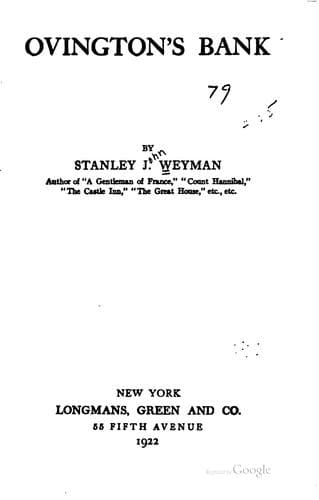
Banks and banking -- Fiction; England -- Social life and customs -- 19th century -- Fiction; Love stories
She obeyed him, but in fear and trembling, for there was not only the
awkward stile to climb, but the track ran over outcrops of rocks on
which even a careful walker might slip. However, he crossed the stile
with ease, aided less by her arm than by his own memory of its shape,
and of every stone that neighbored it; and it was only over the
treacherous surface of the rock that he showed himself really dependent
on her care. Memory could not help him here, and here it was, as he
leant on her shoulder, that she felt, her breast swelling with pity,
the real, the blood tie between them. Her heart went out to him, and
her eyes were dim with tears when at length they stood again on the
high road, and viewed, on a level with themselves but divided from them
by the trough of green meadows in which the brook ran, the gables and
twisted chimneys, the buttressed walls, that gave to Garth its air of a
fortress.
The girl gazed at it, the old man’s hand still on her shoulder. It was
her home: she knew no other, she had never been fifty miles from it. It
stood for peace, safety, protection. She loved it—never more than now,
and never as much as now. And never as much as now had she loved her
father; never before had she understood him so well. The last hour had
wrought a change, dimly suspected by both, in their relations. They
stood on a level—more on a level, at any rate; with no gulf between
them but the natural interval of years, a green valley as it were,
which the eyes of understanding and the light foot of love could cross
at will.
CHAPTER XXVI
A week and a day went by after the banker’s return and there was no run
upon the bank. But afar off, in London and Manchester and Liverpool,
and even in Birmingham, there were shocks and upheavals, failures and
talk of failures, fear in high places, ruin in low. For there was no
doubt about the crisis now. The wheels of trade, which had for some
time been running sluggishly, stopped. It was impossible to sell goods,
for the prudent and foreseeing had already flung their products upon
the market, and glutted it, and later, others had come in and, forced
to find money, had sold down and down, procuring cash at any sacrifice.
Now it was impossible to sell at all. Men with the shelves of their
warehouses loaded with goods, men whose names in ordinary times were
good for thousands, could not find money to meet their trade bills, to
pay their wages, to discharge their household accounts.
Public-domain text, read in full here on John Shaqi.
Reviews
Reviews
No reviews yet
Be the first to share your thoughts on this work.
Elsewhere in the archive
Join the Discussion
Join the discussion
Sign in to leave a comment or review.
Sign InorCreate an account