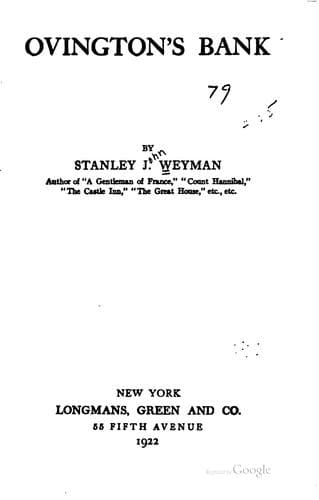
Banks and banking -- Fiction; England -- Social life and customs -- 19th century -- Fiction; Love stories
There was a great panic. The centres of commerce and trade were
convulsed. The kings of finance feared for themselves and closed their
pockets. The Bank of England would help no one. Men who had never
sought aid before, men who had held their heads high, waited, vain
petitioners, at its doors.
Fortunately for Ovington’s, Aldersbury lay at some distance from the
centres of disturbance, and for a time, though the storm grumbled and
crackled on the horizon, the town remained calm. But it was such a calm
as holds the tropic seas in a breathless grip, before the typhoon,
breaking from the black canopy overhead, whirls the doomed bark away,
as a leaf is swept before our temperate blasts. Throughout those six
days, though little happened, anything, it was felt, might happen. The
arrival of every coach was a thing to listen for, the opening of every
mail-bag a terror, the presentation of every bill a pang, the payment
of every note a thing at which to wince; while the sense of danger,
borne like some infection on the air, spread mysteriously from town to
village, and village to hamlet, to penetrate at last wherever one man
depended on another for profit or for subsistence. And that was
everywhere.
A storm impended, and no man knew where it would break, or on whom it
would fall. Each looked in his neighbor’s face and, seeing his fear
reflected, wondered, and perhaps suspected. If so-and-so failed, would
not such-an-one be in trouble? And if such-an-one “went,” what of
Blank—with whom he himself had business?
The feeling which prevailed did not in the main go beyond uneasiness
and suspicion. But, in quarters where the facts were known and the
peril was clearly discerned, these days of waiting were days—nay, every
day was a week—of the most poignant anxiety. In banks, where those
behind the scenes knew that not only their own stability and their own
fortunes were at stake, but that if they failed there would be
lamentation in a score of villages and loss in a hundred homes,
endurance was strained to the breaking point. To show a cheerful face
to customers, to chat over the counter with an easy air, to smile on a
visitor who might be bringing in the bowstring, to listen unmoved to
the murmur in the street that might presage bad news—these things made
demands on nerve and patience which could not be met without distress.
And every hour that passed, every post that came in, added to the
strain.
Public-domain text, read in full here on John Shaqi.
Reviews
Reviews
No reviews yet
Be the first to share your thoughts on this work.
Elsewhere in the archive
Join the Discussion
Join the discussion
Sign in to leave a comment or review.
Sign InorCreate an account