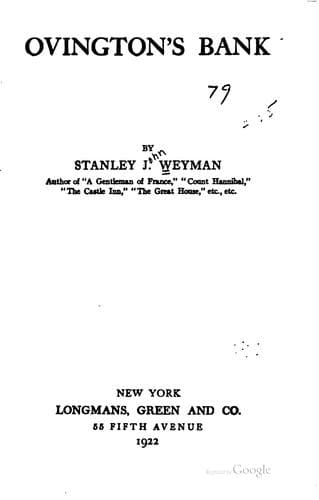
Banks and banking -- Fiction; England -- Social life and customs -- 19th century -- Fiction; Love stories
At any rate the thought of failure had not entered into Arthur’s mind,
and mainly for this reason he, who in fair weather had been most
confident and whose ability had shone most brightly, now cut an
indifferent figure. It was not that his talent or his judgment failed;
in these he still threw Clement and Rodd into the shade. But the risk,
suddenly disclosed, was too much for him. It depressed him. He grew
crabbed and soured, his temper flashing out on small provocation. He
sneered at Rodd, he snubbed the clerks. When it was necessary to refuse
a request for credit—and the necessity arose a dozen times a day—his
manner lacked the suavity that makes the best of a bad thing.
In very truth they were trying times. Men who had bought shares through
Ovington’s, and might have sold them at a profit but had not, could not
understand why the bank would not now advance money on the security of
the shares, would not even pay calls on them, and had only advice, and
that unpalatable, at their service. They came to the parlor and argued,
pleaded, threatened, stormed. They would close their accounts, they
would remove them to Dean’s, they would publish the treatment that they
had received! Again, there were those who had bought railway shares,
which were now at a considerable discount and looked like falling
farther; the bank had issued them—they looked to the bank to take them
off their hands. More trying still were the applications of those who,
suddenly pressed for money, came, pallid and wiping their foreheads
with bandanna handkerchiefs, to plead desperately for a small
overdraft, for twenty, forty, seventy pounds—just enough to pay the
weekly wage-bill, or to meet their household outgoings, or to settle
with some pressing creditor. For all creditors were now pressing. No
man gave time, no man trusted another, and for those in the bank the
question was, How long would they trust Ovington’s? For every man who
left the doors of the bank after a futile visit, every man who went
away with his request declined, became a potential enemy, whose
complaint or chance word might breed suspicion.
“Still, every day is a day gained,” the banker said as he dropped his
mask on the Friday afternoon and sank wearily into a chair. It was
closing time, and the clerks could be heard moving in the outer room,
putting away books, counting the cash, locking the drawers. Another day
had passed without special pressure. “Time is everything.”
Arthur shrugged his shoulders. “It would be, if it were money.”
“Well, I think that we are doing capitally—capitally so far,” said
Clement.
“I am glad you are satisfied,” Arthur retorted. “We are four hundred
down on the day! I can’t think, sir”—peevishly—“why you let Purslow
have that seventy pounds.”
Public-domain text, read in full here on John Shaqi.
Reviews
Reviews
No reviews yet
Be the first to share your thoughts on this work.
Elsewhere in the archive
Join the Discussion
Join the discussion
Sign in to leave a comment or review.
Sign InorCreate an account