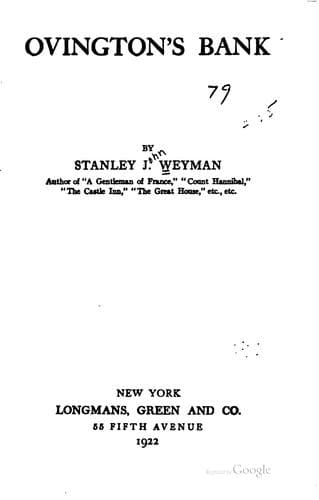
Banks and banking -- Fiction; England -- Social life and customs -- 19th century -- Fiction; Love stories
“Well, he is a very old customer,” the banker replied patiently, “and
he’s hard hit—he wanted it for wages, and I fear that he’s behindhand
with them. And if we withhold all help, my boy, we shall certainly
precipitate a run. On Monday those bills of Badger’s fall due, and I
think will be met. We shall receive eleven hundred from them. On
Tuesday another bill for three hundred and fifty matures, and I think
is good. If we can go on till Wednesday we shall be a little stronger
to meet the crisis than we are to-day. And we can only live from day to
day”—wearily. “If Pole’s bank goes”—he glanced doubtfully at the
door—“I fear that Williams’s will follow. And then——”
“There will be the devil to pay!”
“Well, we must try to pay him!”
“Bravo, sir!” Clement cried. “That’s the way to talk.”
“Yes, it is no use to dwell on the dark side,” his father agreed. “All
the same”—he was silent a while, reviewing the position and making
calculations which he had made a hundred times before—“all the same, it
would make all the difference if we had that twelve thousand pounds in
reserve.”
“By Jove, yes!” Arthur exclaimed. For a moment hope animated his face.
“Can you think of no way of getting it, sir?”
The banker shook his head. “I have tried every quarter,” he said, “and
strained every resource. I cannot. I’m afraid we must fight our battle
as we are.”
Arthur gazed at the floor. The elder man looked at him and thought
again of the Squire. But he would not renew his suggestion. Arthur knew
better than he what was possible in that quarter, and if he saw no
hope, there doubtless was no hope. At best the idea had been fantastic,
in view of the prejudice which the Squire entertained against the bank.
While they pondered, the door opened, and all three looked sharply
round, the movement betraying the state of their nerves. But it was
only Betty who entered—a little graver and a little older than the
Betty of eight or nine months before, but with the same gleam of humor
in her eyes. “What a conclave!” she cried. She looked round on them.
“Yes,” Arthur answered drily. “It wants only Rodd to be complete.”
“Just so.” She made a face. “How much you think of him lately!”
“And unfortunately he’s taken his little all and left us.”
The shot told. Her eyes gleamed, and she colored with anger. “What do
you mean? Dad”—brusquely—“what does he mean?”
“Only that we thought it better,” the banker explained, “to make Rodd
safe by paying him the little he has with us.”
“And he took it—of course?”
The banker smiled. “Of course he took it,” he said. “He would have been
foolish if he had not. It was only a deposit, and there was no reason
why he should risk it with us—as things are.”
“Oh, I see. Things are as bad as that, are they? Any other rats?”—with
a withering look at Arthur.
“I am afraid that there is no one else who can leave,” her father
answered. “The gangway is down now, my dear, and we sink or swim
together.”
Public-domain text, read in full here on John Shaqi.
Reviews
Reviews
No reviews yet
Be the first to share your thoughts on this work.
Elsewhere in the archive
Join the Discussion
Join the discussion
Sign in to leave a comment or review.
Sign InorCreate an account