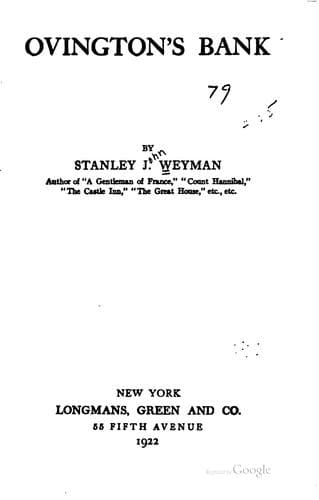
Banks and banking -- Fiction; England -- Social life and customs -- 19th century -- Fiction; Love stories
“Very well,” Arthur said, and was half-way to the door when again, as
if to try his patience, the old man stopped him. “What’s this they’re
saying about Ovington’s, eh? ’Bout the bank? Pretty thing, if he’s let
you in and your money too! But I’m not surprised. I told you you were a
fool, young man, to dirty your hands in that bag, whatever you thought
to get out of it. And if you’re not going to get anything out of it,
but to leave your own in, as I hear talk of—what then? Come, let’s hear
what you have to say about it! I’d like to know.”
“I don’t know what you’ve heard, sir,” Arthur answered, sparring for
time. For self-control, provoking as the old man was, he had no longer
need to fight. For he had seen, the moment the Squire spoke, that here,
here if he chose to avail himself of it, was his chance of the twelve
thousand! Here was an opening, if he had the courage to seize it.
Granted the chance was desperate, and the opening unpromising—a poorer
or less promising could hardly be. And the courage necessary was great.
But here it was. The Squire himself had brought up the subject. He knew
of the rumors: he had broken the ice. Here it was, and for a moment,
uncertain, wavering, giddy with the swift interchange of _pros_ and
_cons_, Arthur tried for time—time to think. “What was it? What did you
hear, sir?” he asked.
“What did I hear?” the Squire answered. “Why, that they’re d—d
suspicious of them in the town. And I don’t wonder. Up in a night, and
cut off in a day, like a rotten mushroom!” He spoke with gusto,
forgetting for the moment what this might mean to his listener; who, on
his side, hardly heeded the brutality, so absorbed was he in the
question which he must answer—the question whether it would be wise or
foolish, ruin or salvation, to ask the Squire for help. “He’ll be
another Fauntleroy, ’fore he’s done,” the old man went on with relish.
“He’ll stretch a rope, you’ll see if he won’t! I told him as much
myself. I told him as much in those very words the day he came here
about his confounded silly toy of a railroad. He might take in
Woosenham and a lot of other fools, I told him, but he did not deceive
me. Now I hear that he’s going to burst up, and where’ll you be, my
lad? Where’ll you be? By Gad, you may be in the dock with him!”
Certainly he might speak on that. The old man was harsh and
hard-fisted, but he was also hard-headed and very shrewd; and
conceivably the case might be so put to him that he might see his
profit in it. Certainly it might be so put that he might see a fair
prospect of saving his nephew’s five thousand at no great risk to
himself. The books might be laid before him, the figures be taken out,
the precise situation made clear. There was—it could not be put higher
than this—just a slender chance that he would listen, prejudiced as he
was.
Public-domain text, read in full here on John Shaqi.
Reviews
Reviews
No reviews yet
Be the first to share your thoughts on this work.
Elsewhere in the archive
Join the Discussion
Join the discussion
Sign in to leave a comment or review.
Sign InorCreate an account