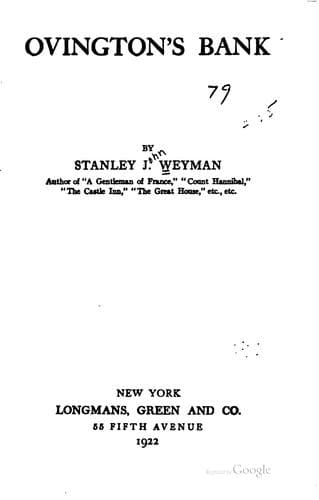
Banks and banking -- Fiction; England -- Social life and customs -- 19th century -- Fiction; Love stories
But twelve thousand! It was such a stupendous sum to name. It needed
such audacity to ask for it. And yet it was that or nothing. Less might
not serve; while to ask for less, to ask for anything at all, might
cost the petitioner the favor he had won—his standing in the house, and
the advantages which the Squire’s support might still gain for him. And
then it was such a forlorn hope, such a desperate, feckless venture!
No, he would be a fool to risk it. He dared not do it. He had not the
face.
Yet, for a few seconds after the Squire had ceased to speak, Arthur
hesitated, confession trembling on his lips. The twelve thousand would
make all good, save all, redeem all—ay, and bind Ovington to him in
bonds of steel. But no, he dared not. He would be a fool to speak. And
instead of the words that had risen to his lips, “I think you mistake,
sir,” he said coldly. “I think you’ll find that this is all cry and
little wool! Of course money is tight, and there is trouble in the
City. I’ve heard talk of two or three weak banks being in difficulties,
and I should not wonder if one or two of them stopped payment between
this and Christmas. We are told that it is likely. But we are perfectly
solvent. It will take more than talk to bring Ovington’s down.”
“Umph!” the Squire grumbled. “Well, maybe, maybe. You talk as if you
knew, and you ought to know. I hope you do know. After all—I don’t want
you to lose your money—Gad, a pretty fool you’d look, my lad! A pretty
fool, indeed! But as for Ovington, a confounded rascal, who thinks
himself a gentleman because he has filled his purse at some poor
devil’s expense—I’d see him break with pleasure.”
“I don’t think you’ll have the pleasure this time!” Arthur retorted
with a bitterness which he could not repress—a bitterness caused as
much by his own doubts as by the other’s harshness. He left the room
without more, the keys in his hand, and went downstairs.
It wanted about an hour of the Squire’s dinner-time, but Calamy had
laid the table early, and the dining-room was dark. Arthur carried in a
lamp from the hall, and himself closed the shutters. He locked the
door. Then he opened the nearer panel and the cupboard behind it, and
sought for and found the agreement—but all mechanically, his mind still
running on the Squire’s words, and now approving of the course he had
taken, now doubting if he had not missed his opportunity. The agreement
in his hand, his errand done, he closed the cupboard door, and was
preparing to close the panel, when, with his hand still on it, he
paused. More clearly than when his bodily eyes had rested upon them he
saw the contents of the cupboard.
Public-domain text, read in full here on John Shaqi.
Reviews
Reviews
No reviews yet
Be the first to share your thoughts on this work.
Elsewhere in the archive
Join the Discussion
Join the discussion
Sign in to leave a comment or review.
Sign InorCreate an account