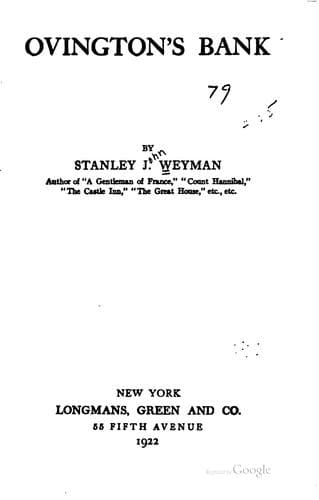
Banks and banking -- Fiction; England -- Social life and customs -- 19th century -- Fiction; Love stories
And one thing in particular, a small thing, but it was on this that his
mind focussed itself—the iron box containing the India Stock. He saw it
before him; it stood out dark, its every outline sharp. And with equal
clearness he saw its contents, the two certificates that remained in
it. He recalled the value of them, and almost against his will he
calculated their worth at the price of the day. India Stock, sound and
safe security as it was, had fallen more than thirty points since the
Squire had sold. It stood to-day, he thought, at two hundred and forty
or a little over or a little under—somewhere about that. At the lowest
figure five thousand pounds would fetch—just twelve thousand, he
calculated.
Twelve thousand!
He stood staring at the door, and even by the yellow light of the lamp
his face looked pale. Twelve thousand! And upstairs in a pigeon-hole of
the old bureau, where he had carelessly thrust it, was the blank
transfer.
It seemed providential. It seemed as if the stock—stock to the precise
amount he required—had been placed there for a purpose. Twelve
thousand! And realizable, no matter what the pinch. If he borrowed it
for a month, what harm would there be? Or what risk? The bank was
solvent, he knew that: give it time, and it would stand as strong as
ever. Within a month, or two months at the most, he could replace the
stock, and no one would be the wiser. And the bank and his own fortune
would be saved.
Whereas—whereas, if the bank failed, he lost everything. And what was
it his uncle had said? “A pretty fool you will look!” It was true, it
was horribly true. He would be the laughing stock of the county. Men of
his own class would say with a sneer that it served him right. And the
Squire—what would he say? His life would be a hell!
Still he hesitated, though he told himself that it was not by boggling
at trifles that men arrived at great ends—nor by poltroonery. And who
would be the loser? No one. It would be all gain. The Squire, if he had
common sense, would be the first to wish it done.
Yet, as he felt through the bunch, with fingers that shook a little,
for the small key that opened the box, he glanced fearfully over his
shoulder. But the door of the room was locked, the windows were
shuttered: no one could see him. No one could ever say what he had done
in that room. And he was lawfully there, at the Squire’s own request,
on his errand.
Five minutes later he closed the door, closed the panel. He took up the
lamp with a steady hand and left the room. He went into the Squire’s
bedroom to return the keys, loitered a minute or two at the bureau,
then he went to his own room. On the table lay the lease and the
counterpart that he had brought from Aldersbury for the old man’s
signature. He closed and locked the door.
Public-domain text, read in full here on John Shaqi.
Reviews
Reviews
No reviews yet
Be the first to share your thoughts on this work.
Elsewhere in the archive
Join the Discussion
Join the discussion
Sign in to leave a comment or review.
Sign InorCreate an account