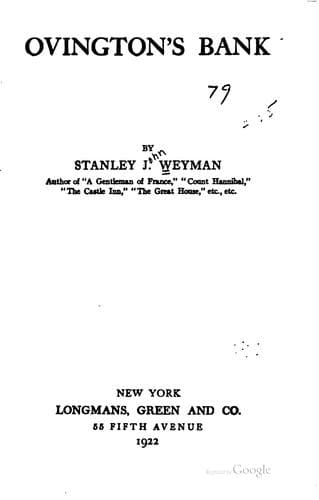
Banks and banking -- Fiction; England -- Social life and customs -- 19th century -- Fiction; Love stories
The Squire, pleased with himself, and glad that the business was over,
was in a good humor, and he joined in the laugh. “It will teach you not
to be too free with your signature, my girl,” he said. “When you come
some day to have a cheque book, you’ll find that that won’t do! Won’t
do, at all! Well, thank God, that’s done.”
Arthur, who was stooping over the table, adding his own name, completed
his task. He stood up. “Yes, sir, that’s done. Done!” he repeated in an
odd, rising tone. “And now—the lease goes back to Welsh’s. Shall I lock
up the counterpart—downstairs, sir?”
“No, lad,” the Squire announced. “I’ll do that myself o’ Monday.”
“But it’s no trouble, sir.” He held out his hand for the keys. “And
perhaps the sooner it’s locked up—the tenant’s signed it, and it is
complete now—the safer.”
But, “No, no, time enough!” the Squire persisted. “I’ll put it back on
Monday. I am not so helpless now I can’t manage that, and I shall be
downstairs o’ Monday.”
For a moment Arthur hesitated. He looked as if something troubled him.
But in the end, “Very good, sir. Then that’s all?” he said.
“Ay; put the counterpart in the old bureau there. ’Twill be safe there
till Monday. How’s the wine? Fill my glass and fill your own, lad. You
can go, Jos. Tell Calamy to come to me at half-past nine.”
CHAPTER XXVIII
The next day, Sunday, was raw and wet. Mist blotted out the hills, and
beneath it the vale mourned. The trees dripped sadly, pools gathered
about the roots of the beeches, the down-spouts of the eaves gurgled
softly in the ears of those who sat near the windows. Miss Peacock
alone ventured to church in the afternoon, Arthur walking with her as
far as the door, and then going on to the Cottage to have tea with his
mother. Josina stayed at home in attendance on her father, but ten
minutes after the others had left the house, he dismissed her with a
fractious word.
She went down to the dining-room, where she could hear his summons if
he tapped the floor. She poked up the smouldering logs, and looked
through the windows at the dreary scene—the day was already drawing
in—then, settling herself before the fire, she opened a book. But she
did not read, indeed she hardly pretended to read, for across the page
of the Sunday volume, in black capitals, blotting out the type, forcing
itself on her brain, insistent, inexorable, unavoidable, the word
“When?” imprinted itself.
Ay, when? When was she going to summon Clement, and give him leave to
speak? When was she going to keep her word, to make a clean breast of
it to her father and confront the storm, the violence of which her
worst fears could not picture or exaggerate?
“When?”
Public-domain text, read in full here on John Shaqi.
Reviews
Reviews
No reviews yet
Be the first to share your thoughts on this work.
Elsewhere in the archive
Join the Discussion
Join the discussion
Sign in to leave a comment or review.
Sign InorCreate an account