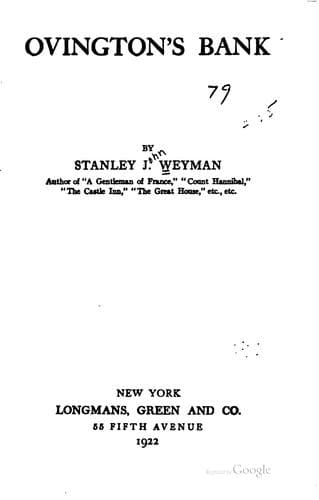
Banks and banking -- Fiction; England -- Social life and customs -- 19th century -- Fiction; Love stories
With every day of the past fortnight the question had confronted her
with growing insistence. Now, in this idle hour, with the house silent
about her, with nothing to distract her thoughts, it rose before her,
grim as the outlook. It would not be denied, it came between her and
the page, it forced itself upon her, it called for, nay, it insisted
upon, an answer. When?
There was no longer any hope that the Squire would regain his sight, no
longer any fear for his general health. He was as well as he ever would
be, as well able to bear the disclosure. Delay on that ground was a
plea which could no longer avail her or deceive her. Then, when? Or
rather, why not now? Her conscience told her, as it had told her often
of late, that she was playing the coward, proving false to her word,
betraying Clement—Clement whom she loved, and whom, craven as she was,
she feared to acknowledge.
Then, when? Surely now, or not at all.
Alas, the longer she dwelt on the avowal she must make, the more
appalling the ordeal appeared. Her father, indeed, had been more gentle
of late; that walk on the hill had brought them closer together, and
since then he had shown himself more human. Glimpses of sympathy, even
of affection, had peeped through the chinks of his harshness. But how
difficult was the position! She must own to stolen meetings, to
underhand practices, to things disreputable; she must proclaim, maid as
she was, her love. And her love for whom? A stranger, and worse than a
stranger—a nobody. Then apart from her father’s contempt for the class
to which Clement belonged, and with which he was less in sympathy than
with the peasants on his lands, his prejudice against the Ovingtons was
itself a thing to frighten her! Hardly a day passed that he did not
utter some jibe at their expense, or some word that betrayed how sorely
Arthur’s defection rankled. And then his blindness—that added the last
touch of deceit to her conduct, that made worse and more clandestine
what had been bad before. As she thought of it, and imagined the avowal
and the way in which he would take it, the color left her cheeks and
she shivered with fright. She did not know how she could do it, or how
she could live through it. He would lose all faith in her. He would
pluck from his heart even that affection for her which she had begun to
discern under the mask of his sternness—to discern and to cherish.
Yet time pressed, she could no longer palter with her love, she must be
true to Clement now or false, she must suffer for him now or play the
coward. She had given him her word. Was she to go back on it?
Public-domain text, read in full here on John Shaqi.
Reviews
Reviews
No reviews yet
Be the first to share your thoughts on this work.
Elsewhere in the archive
Join the Discussion
Join the discussion
Sign in to leave a comment or review.
Sign InorCreate an account