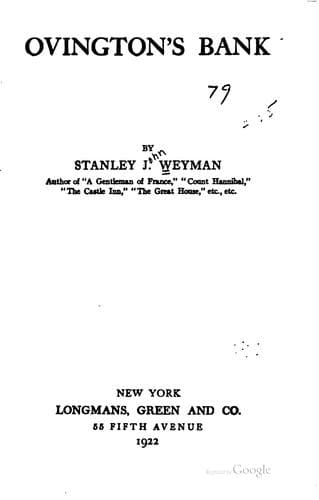
Banks and banking -- Fiction; England -- Social life and customs -- 19th century -- Fiction; Love stories
Oh, never! never! she thought, and pressed her hands together. Those
spring days when she had walked with him beside the brook, when his
coming had been sunshine and her pulses had leapt at the sound of his
footsteps, when his eyes had lured the heart from her and the touch of
his lips had awakened the woman in her, when she had passed whole days
and nights in sweet musings on him—oh, never!
No, he had urged her to be brave, to be true, to be worthy of him; and
she must be. She must face all for him. And it would be but for a time.
He had said that her father might separate them, and would separate
them: but if they were true to one another——
“Miss! Miss Josina!”
She turned, her dream cut short, and saw Molly, the kitchen-maid,
standing in the doorway. She was surprised, for the stillness of a
Sunday afternoon held the house—it was the servants’ hour, and one at
which they were seldom to be found, even when wanted. “What is it?” she
asked, and stood up, alarmed. “Has my father called?” He might have
rapped, and deep in thought she might not have heard him.
“No, miss,” Molly answered—and heaven knows if Molly had an inkling of
the secret, but certainly her face was bright with mischief. “There is
a gentleman asking for you, if you please, miss. He bid me give you
this.” She held out a three-cornered note.
Josina’s face burned. “A gentleman?” she faltered.
“Yes, miss, a young gentleman,” Molly answered demurely.
Josina took the note—what else could she do?—and opened it with shaking
fingers. For a moment, such was her confusion, she failed to read the
few words it contained. Then she collected herself—the words became
plain: “Very urgent—forgive me and see me for ten minutes.—C.”
Very urgent? It must be urgent indeed, or, after all she had said, he
would not come to her unbidden. She hesitated, looking doubtfully and
shamefacedly at Molly. But the eyes of young kitchen-maids are sharp,
and probably this was not the first glimpse Molly had had of the young
mistress’s love story, or of the young gentleman. “You can slip out
easy, miss,” she said, “and not a soul the wiser. They are all off
about their business.”
“Where is he?”
“He’s under the garden wall, miss—down the lane.”
Jos took her courage in her hands. She snatched up a shawl from the
hall-table, and with hot cheeks she went out through the back regions,
Molly accompanying her as far as the yard. “I’ll be about the place,
miss,” the girl said—if no one else was enjoying herself, she was.
“I’ll rattle the milk-pail if—if you’re wanted.”
Josina drew the shawl about her head, and went down the yard, passing
on her right the old stable, which bore over its door the same date as
the table in the hall—1691. A moment, and she saw Clement waiting for
her under the eaves of the Dutch summer-house, of which the sustaining
wall overhung the lane, and, with the last of the opposing outhouses,
formed a sort of entrance to the yard.
Public-domain text, read in full here on John Shaqi.
Reviews
Reviews
No reviews yet
Be the first to share your thoughts on this work.
Elsewhere in the archive
Join the Discussion
Join the discussion
Sign in to leave a comment or review.
Sign InorCreate an account