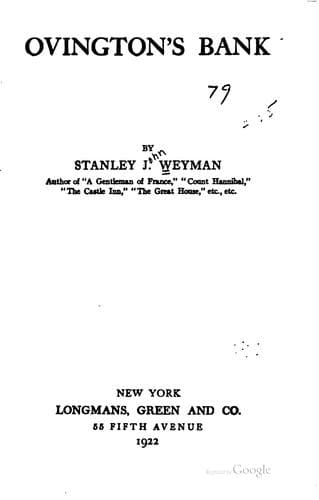
Banks and banking -- Fiction; England -- Social life and customs -- 19th century -- Fiction; Love stories
“Oh, he had gone off, across the fields.”
“Before Arthur came up, do you mean?”
“To be sure, some time before. However——”
But, “No, Clement, I want to understand this,” she insisted, breaking
in on him. Her voice betrayed her excitement, and to hold him to the
point she laid her hands on his shoulders, standing before him and
close to him. “Tell me again, and clearly. Do you mean that it was you
who drove Thomas off? Before Arthur came up?”
He stared. “Well, of course it was,” he said. “Didn’t you know that?
Didn’t Arthur tell you?”
She avoided the question, and instead, “Then it was your coat that was
spoiled?” she said. “This coat?”
“Well, of course it was. You can see that.”
She looked at him, her cheeks flushed, her pride in him showing in her
eyes. He had indeed justified her choice of him, her belief in him, her
confidence in him. He had done this and had said nothing. The day was
cold, and she was not warmly clad, but she felt no cold—now. It was
raining, but she was no longer aware of it. There had sprung up in her
heart, not only courage, but a faint, a very faint hope.
He had come to dash her down, to fill her cup of sorrow to the brim, to
leave her lonely in the world and comfortless—for never, never could
she love another! And instead he had given her hope—a hope forlorn and
far off, gleaming faint as the small stars in distant Cassiopeia, and
often doubt, like an evening mist, would veil it. But it sparkled, she
saw it, she drew courage from it.
Meanwhile, surprised by the turn her thoughts had taken, he was still
more surprised by the change in her looks, the color in her cheeks, the
light in her eyes. He did not understand, and for a moment, seeing
himself no hope but only sorrow and parting, he was tempted to think
that she trifled. What mattered it what coat he wore, or what had
stained it, or the details of a story old now, and which he supposed to
be as well known to her as to him? Perhaps she did not comprehend, and,
“Jos,” he said, inviting her to be serious, “do you understand that
this is our parting?”
But “No! no!” she said resolutely. “We are not going to part.”
“But don’t you see,” sadly, “that I cannot go to your father now? That
next week we may be beggars, and my father a ruined man? I could ask no
man, even a poor man, for his daughter now. I must work to live, work
as a clerk—as, I don’t know what, Jos, but in some position far removed
from your life, and far removed from your class. I could not speak to
your father now, and it is that which has brought me to you to—to say
good-bye, dearest—to part, Jos! The gates are closed, we must go out of
the garden, dear. And you”—he looked at her with yearning eyes—“must
forgive me, before we part.”
“Perhaps we are not going to part,” she said.
He shook his head. He would not deceive her. “Nothing else is
possible,” he said.
Public-domain text, read in full here on John Shaqi.
Reviews
Reviews
No reviews yet
Be the first to share your thoughts on this work.
Elsewhere in the archive
Join the Discussion
Join the discussion
Sign in to leave a comment or review.
Sign InorCreate an account