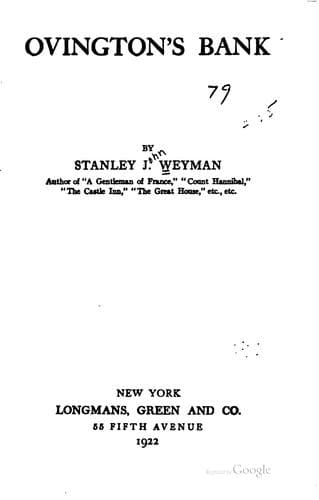
Banks and banking -- Fiction; England -- Social life and customs -- 19th century -- Fiction; Love stories
And Arthur himself? Confound him, what had the lad been doing? Why had
he been silent about the bank’s difficulties and the peril in which his
money stood? For, it was only two days ago that he had denied the
existence of any peril. And then, again, what was this story about that
unlucky night which had cost him his sight? If it really was young
Ovington who had come to his rescue and beaten off Thomas, why had not
Arthur said so? Why had he never let fall a single word about him,
never mentioned the young fellow’s name, never given him the credit
that—that was certainly due to him, rogue as he was, if this story were
true. There was something odd about that—the Squire moved uneasily in
his chair—something underhand and—and fishy! He had a glimpse of Arthur
in a new light, and he did not like what he saw.
He liked it almost less, if that were possible, than he liked another
thing—the idea that this young Ovington’s silence was creditable to
him. If it were indeed he who had done the thing, why had he been quiet
all this time, and never even said “I did it”? If a gentleman had
behaved after that fashion, the Squire would have known what to think
of it. But that this low-bred young cub, who had behaved so
disgracefully to his daughter, should bear himself in that way—no, he
was not going to believe it. After all, the world wasn’t turned upside
down to that extent.
No! For in his connection with the girl the young scamp had shown what
he was—a sneaking, underhand, interloping puppy. In connection with his
girl! As he thought of it, the veins swelled on the Squire’s forehead
and he shook with rage. His girl! “Damn him! Damn him!” he cried,
trembling with passion. And again and again he cursed the man who had
dared to raise his eyes to a Griffin—who had stolen his child’s heart
from him. No fate, no punishment, no lot was too bad for such a one.
Help him! Help him, indeed!
The Squire laughed mirthlessly at the notion.
After that there remained only his daughter to think of, and as he came
back to her and to her share in the matter, more, far more than he
wished, recurred to his memory: her prayers and her pleading, her
clinging arms and her caresses, the tears that had fallen on his hands,
her warm, slender body pressed against his. He could not forget the
sound of her voice in his ears, nor the touch of her hand, nor the feel
of her body. Words that she had used returned and beat on his old
heart, and beat and beat again, tormenting him, trying him, softening,
ay, softening him. He thought of the boy, dead these many years at
Alexandria, and, yes, she was all that he had, all. And he must thwart
her, he must make her unhappy. It was his duty. She knew not what she
asked. And she had behaved ill, ay, very ill.
Public-domain text, read in full here on John Shaqi.
Reviews
Reviews
No reviews yet
Be the first to share your thoughts on this work.
Elsewhere in the archive
Join the Discussion
Join the discussion
Sign in to leave a comment or review.
Sign InorCreate an account