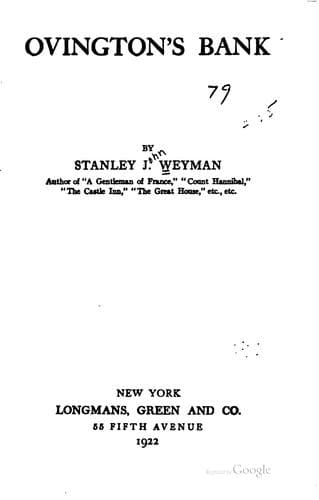
Banks and banking -- Fiction; England -- Social life and customs -- 19th century -- Fiction; Love stories
But on that, with a vividness which the reflection had never assumed
before—for the old man, like other old men, did not feel old—he saw
that he had but a very short span to live—a year or two, or it might be
three or four years. The last page of his life was all but turned, the
book was near its end. Two or three years and all that he treasured
would be hers. Even now he was dependent on her for care and affection,
and to the last he must be dependent. A little while and she would be
alone, her own mistress; and he who had ruled his lands and his people
for more than half a century would be a memory. A memory of what?
Again, and yet again, he felt her arms about his knees, her little head
pressed against his breast. Again and yet again her tears, her prayers
beat upon his heart. She was a silly woman-child, a fool; but a dear
fool, made dear to him in the very hour of her misbehavior. It was his
duty to deny her. It was for him to order, for her to obey. And yet,
“He saved your life!” that cry so oft repeated, so often dinned into
his ears, that, too, came back to him. And before he was aware of it he
was wondering what manner of man this young fellow was, what spell he
had woven about the girl, whence his power over her.
And why had the man been silent about that night? Had he in truth
intended to beard him and claim her in the road that morning—when they
met? He remembered it.
The son of that man, Ovington! Lord Almighty! It could hardly be worse.
And yet “He saved your life!” The Squire could not get over that—if it
were true. If it were really true.
He thought upon it long, forced out of the usual current of his life.
Miss Peacock, bringing up his frugal luncheon, found him silent, sunk
low in his chair, his chin upon his breast. So he appeared when anyone
stole in during the next two hours to attend to the fire or to light
his pipe. Calamy, safe outside the door, uttered his misgivings. “It’s
the torpor,” he told Miss Peacock, shaking his head. “That’s how it
takes them before the end, miss. I’ve seen it often. The torpor! He’ll
not be long now!”
Miss Peacock scolded the butler, but was none the less impressed, and
presently she sought Josina, who was lying down in her room with a
headache. She imparted her fears to the girl, and unwillingly Jos rose,
and bathed her face and tidied her hair, and by and by came out. She
must take up the burden of life again.
By that time Miss Peacock had disappeared, and Josina went down alone.
Half-way down the upper flight she halted, for she heard a slow, heavy
step descending the stairs below her. She looked down the well of the
staircase, and to her astonishment she saw her father going down before
her, stair by stair, his hand on the rail, a paper and his stick in the
other hand. It was not the first time that he had done such a thing,
but hitherto some one had always gone with him, to aid him should aid
be necessary.
Public-domain text, read in full here on John Shaqi.
Reviews
Reviews
No reviews yet
Be the first to share your thoughts on this work.
Elsewhere in the archive
Join the Discussion
Join the discussion
Sign in to leave a comment or review.
Sign InorCreate an account