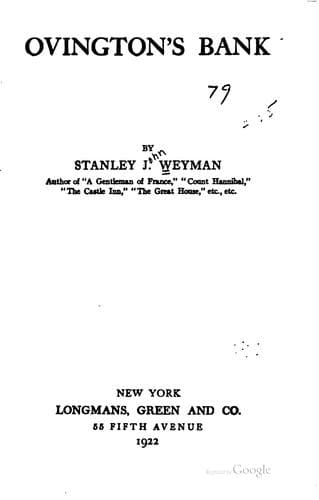
Banks and banking -- Fiction; England -- Social life and customs -- 19th century -- Fiction; Love stories
Clement had never seen anything like it, and he viewed it with awe, his
ears deafened by the babel or pierced by the shrill cries of the
news-sellers who constantly bawled, “Panic! Great panic in the City!
Panic! List of banks closed!” He had heard as he changed at Barnet that
fourteen houses in the City had shut their doors, but he had not
appreciated the fact. Now he was to see with his own eyes shuttered
windows and barred doors with great printed bills affixed to them, and
huge crowds at gaze before them, groaning and hooting. Even the shops
bore singular and striking witness to the crisis, for in Cheapside
every other window exhibited a card stating that they would accept
bank-notes to any extent and for goods to any amount—a courageous
attempt to restore public confidence which deserved more success than
it won; while there, and on all sides, he heard men execrating the Bank
of England and loudly proclaiming—though this was not the fact—that it
had published a notice that it could no longer pay cash.
Here was panic indeed! Here was an appalling state of things! And very
low his heart sank, as the chaise made a few yards, stopped, and
advanced again. What chance had Ovington’s, what hope of survival had
their little venture, when the very credit of the country tottered, and
here in the heart of London age-long institutions with vast deposits
and forty or fifty branches toppled down on all sides? When merchant
princes with tens of thousands in sound but unsaleable securities could
do nothing to save themselves, and men of world-wide fame, the giants
of finance, went humbly, hat in hand, to ask for time?
Stranded, or moving at a snail’s pace, he caught scraps of the talk
about him. Smith’s in Mansion House Street had closed its doors.
Everett and Walker’s had followed Pole’s into bankruptcy. Wentworth’s
at York had failed for two hundred thousand pounds. Telford’s at
Plymouth had been sacked by an angry mob. The strongest bank in Norwich
was going or gone. The Bank of England had paid out eight millions in
gold within the week—and had no more. They were paying in one-pound
notes now, a set found God knows where—in the cellars, it was said. The
tellers were so benumbed with terror that they could not separate them
or count them.
Public-domain text, read in full here on John Shaqi.
Reviews
Reviews
No reviews yet
Be the first to share your thoughts on this work.
Elsewhere in the archive
Join the Discussion
Join the discussion
Sign in to leave a comment or review.
Sign InorCreate an account