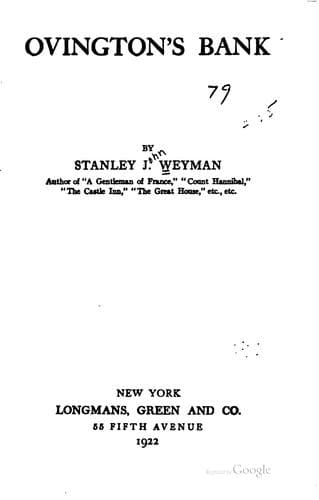
Banks and banking -- Fiction; England -- Social life and customs -- 19th century -- Fiction; Love stories
For the moment he forgot Arthur and Arthur’s business, and thought only
of his father and of their own plight. “We are gone!” he reflected, his
face almost as pale as the faces in the street. “We are ruined! There
is no hope. When this reaches Aldersbury we must close!” He could no
longer bear the inaction. He could not sit still. He paid off the
chaise—with difficulty, owing to the press—and pushed forward on foot.
But his mind still ran on Aldersbury, was still busy with the fate of
their own bank. He felt an immense pity for his father, and recognized
that until this moment, when panic in its most dreadful form stared him
in the face, he had not realized the catastrophe, or the sadness, or
the finality of it. They must close. They must begin the world again,
begin it at the bottom, in competition with a multitude of beggared
men, three-fourths of whom had never speculated, never touched a share,
never left the safe path of industrious commerce, but were now to pay
with all they possessed in the world, their daughters’ portions and
their sons’ fortunes, for the recklessness or the extravagance of
others.
For a space there was vouchsafed to him the wider vision, and he saw
the thing that was passing in its true light. He saw the wave of ruin
spread from these crowded streets ever farther and farther, from city
to town and town to country; and where it passed it wrecked homes, it
made widows, it swept away the dowries of children, it separated
lovers, it overwhelmed the happiness of thousands and tens of
thousands. He saw the honest trader, whose father’s good name was his
glory, broken in heart and fortune through the failure of others, his
health shattered, his house sold over his head, his pensioners and
dependants flung into the workhouse. He saw deluded parsons doomed to
spend the close of their lives in a hopeless wrestle with debt, their
sons taken from school, their daughters sent out into a cold and
unfeeling world. He saw squires, the little gods of their domain, men
once wealthy, doomed to drink themselves into forgetfulness of the
barred entail and the lost estate; the great house would be closed, the
agent would squeeze the tenants, and they in turn the laborers, until
the very village shop would feel the pinch. Thousands upon thousands
would lose their hoarded savings, and, too old to begin again, would
sink, they and their children and their children’s children, into the
under-world, there to be lost amid the dregs of the population.
And he and his? Why should they escape? How could they escape? It would
be much if they could feel, while they shared the common lot, that they
had deserved to escape, that they were not of those whose wild
speculations had brought this disaster on their kind.
Public-domain text, read in full here on John Shaqi.
Reviews
Reviews
No reviews yet
Be the first to share your thoughts on this work.
Elsewhere in the archive
Join the Discussion
Join the discussion
Sign in to leave a comment or review.
Sign InorCreate an account