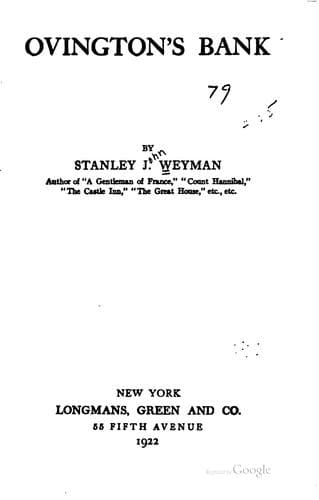
Banks and banking -- Fiction; England -- Social life and customs -- 19th century -- Fiction; Love stories
To do him justice, Arthur had hitherto seen the thing only by his own
lights. He had looked on it as a case of all for fortune and the rest
well lost, and he had even pictured himself in the guise of a hero, who
took the risks and shared the benefits. If the act were ill, at least,
he considered, he did it in a good cause; and where, after all, was the
harm in assuming a loan of something which would never be missed, which
would be certainly repaid, and which, in his hands, would save a
hundred homes from ruin? The argument had sounded convincing at the
time.
Then, for the risk, what was it, when examined? It was most unlikely
that the Squire would discover the trick, and if he did he could not,
hard and austere as he was, prosecute his own flesh and blood. Nay,
Arthur doubted if he could prosecute, since he had signed the transfer
with his own hand—it was no forgery. At the worst, then and if
discovery came, it would mean the loss of the Squire’s favor and
banishment from the house. Both of these things he had experienced
before, and in his blindness he did not despair of reinstating himself
a second time. He had a way with him, he had come to think that few
could resist him. He was far, very far, from understanding how the
Squire would view the act.
But now the mists of self-deception were for the moment blown aside,
and he saw the gulf on the edge of which he stood, and into which a
word might precipitate him. If the pig-headed fool before him did what
he said he would, and preferred a charge, the India House might take it
up; and, pitiless where its interests were in question, it might prove
as inexorable as the Bank had proved in the case of Fauntleroy only the
year before. In that event, what might not be the end? His uncle had
signed the transfer, and at the time that had seemed enough; it had
seemed to secure him from the worst. But now—now when so much hung upon
it, he doubted. He had not inquired, he had not dared to inquire how
the law stood, but he knew that the law’s uncertainties were proverbial
and its ambages beyond telling.
And the India House, like the Bank of England, was a terrible foe. Once
launched on the slope, let the cell door once close on him, he might
slip with fatal ease from stage to stage, until the noose hung dark and
fearful before him, and all the influence, all the help he could
command, might then prove powerless to save him! It was a terrible
machine—the law! The cell, the court, the gallows, with what swiftness,
what inevitableness, what certainty, did they not succeed one
another—dark, dismal stages on the downward progress! How swiftly, how
smoothly, how helplessly had that other banker traversed them! How
irresistibly had they borne him to his doom!
Public-domain text, read in full here on John Shaqi.
Reviews
Reviews
No reviews yet
Be the first to share your thoughts on this work.
Elsewhere in the archive
Join the Discussion
Join the discussion
Sign in to leave a comment or review.
Sign InorCreate an account