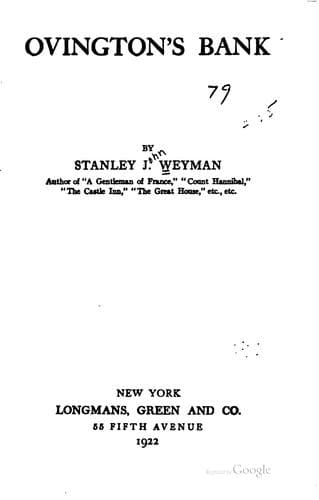
Banks and banking -- Fiction; England -- Social life and customs -- 19th century -- Fiction; Love stories
He shuddered. The officer of the law, who a few minutes before had been
his servant, fee-bound, obsequious, took on another shape. He grew
stern and menacing, and was even now, it might be, observing him, and
conceiving suspicion of him. Arthur’s color ebbed at the thought and
his face betrayed him. The peril might be real or unreal—it might be
only his imagination that he had to fight. But he could not face it. He
moistened his dry lips, he forced himself to speak. He
surrendered—sullenly, with averted eyes.
“Have it your own way,” he said. “Take it.” And with a last attempt at
bravado, “I shall appeal to your father!”
“That is as you will,” Clement said. He was not comfortable, and
sensible of the other’s humiliation, his only wish was to bring the
scene to an end as quickly as possible. He took up the bag and signed
to the officer that they were ready.
“It’s some hundreds short. You know that?” Arthur muttered.
“I can’t help it.”
“He’ll be the loser.”
“Well—it must be so.” Yet Clement hesitated, a little taken aback. He
did not like the thought, and he paused to consider whether it might
not be his duty to return to the brokers’ and undo the bargain. But it
would be necessary to repeat all the formalities at a cost of time that
he could not measure, and it was improbable that he would be able to
recoup the whole of the loss. Rightly or wrongly, he decided to go on,
and he turned to the officer. “I take on the business now,” he said,
sharply. “Where is the hackney-coach? In Bishopsgate? Then lead the
way, will you?” And, the bag in his hand, he moved towards the crowded
street.
But with his foot on the threshold, something spoke in him, and he
looked back. Arthur was standing where he had left him, gloom in his
face; and Clement melted. He could not leave him, he could not bear to
leave him thus. What might he not do, what might he not have it in his
mind to do? Pity awoke in him, he put himself in the other’s place, and
though there was nothing less to his taste at that moment than a
companionship equally painful and embarrassing, he went back to him.
“Look here,” he said, “come with me. Come down with me and face it out,
man, and get it over. It’s the only thing to do, and every hour you
remain away will tell against you. As it is, what is broken can be
mended—if you’re there.”
Arthur did not thank him. Instead, “What?” he cried. “Come? Come with
you? And be dragged at your chariot wheels, you oaf! Never!”
“Don’t be a fool,” Clement remonstrated, pity moving him more strongly
now that he had once acted on it. He laid his hand on the other’s arm.
“We’ll work together and make the best of it. I will, I swear,
Bourdillon, and I’ll answer for my father. But if I leave you here and
go home, things will be said and there’ll be trouble.”
Public-domain text, read in full here on John Shaqi.
Reviews
Reviews
No reviews yet
Be the first to share your thoughts on this work.
Elsewhere in the archive
Join the Discussion
Join the discussion
Sign in to leave a comment or review.
Sign InorCreate an account