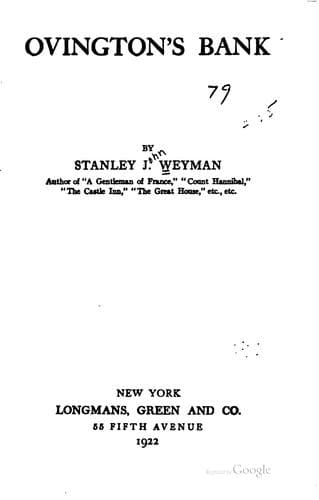
Banks and banking -- Fiction; England -- Social life and customs -- 19th century -- Fiction; Love stories
“Trouble the devil!” Arthur retorted, and shook off his hand. “You have
ruined the bank,” he continued, bitterly, but with less violence, “and
ruined your father and ruined me. I hope you are content. You have been
thorough, if it’s any satisfaction to you. And some day I shall know
why you’ve done it. For your honesty and your clean hands, they don’t
weigh a curse with me. You’re playing your own game, and if I come to
know what it is, I’ll spoil it yet, d—n you!”
“I don’t mind how much you curse me, if you will come,” Clement
answered, patiently. “It’s the only thing to be done, and when you
think it over in cold blood, you’ll see that. Come, man, and put a bold
face on it. It is the brave game and the only game. Face it out now.”
Arthur looked away, his handsome face sullen. He was striving with his
passions, battling with the maddening sense of defeat. He saw, as
plainly as Clement, that the latter’s advice was good, but to take it
and to go with him, to bear for many hours the sense of his presence
and the consciousness of his scorn, his gorge rose at the thought. Yet,
what other course was open to him? What was he going to do? He had
little money with him, and he saw but two alternatives: to blow out his
brains, or to go, hat in hand, and seek employment at the brokers’
where he was known. He had no real thought of the former
alternative—life ran strong in him and he was sanguine; and the latter
meant the overthrow of all his plans, and a severance, final and
complete, from Ovington’s. His lot thenceforth would, he suspected, be
that of a man who had “crossed the fight,” done something dubious, put
himself outside the pale.
Whereas if he went with Clement now, humiliation would indeed be his.
But he would still be himself, and with his qualities he might live it
down, and in the end lose nothing.
So at last, “Go on,” he said, sulkily. “Have it your own way. At any
rate, I may spoil your game!” He shut his eyes to Clement’s generosity.
If he gave a thought to it at all, he fancied that he had some purpose
to serve, some axe of his own to grind.
Public-domain text, read in full here on John Shaqi.
Reviews
Reviews
No reviews yet
Be the first to share your thoughts on this work.
Elsewhere in the archive
Join the Discussion
Join the discussion
Sign in to leave a comment or review.
Sign InorCreate an account