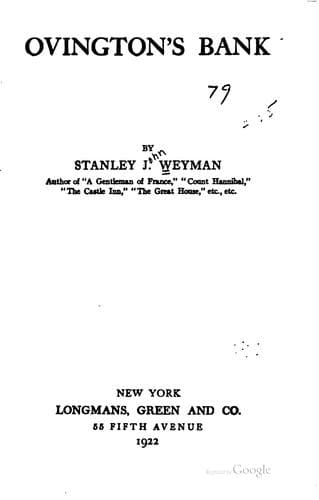
Banks and banking -- Fiction; England -- Social life and customs -- 19th century -- Fiction; Love stories
But under the trivialities there was tense excitement. Now and again a
man who had been slow to take the alarm forced his way, pale and
agitated, through the crowd, to vanish within the doors; or a
countryman, whom the news had only just reached in his boosey-close or
his rickyard—as they call a stackyard in Aldshire—rode up the hill, hot
with haste and cursing those who blocked his road, flung his reins to
the nearest bystander, and plunged into the bank as into water. And on
the fringe, hiding themselves in doorways, or in the dark mouths of
alleys, were men who stood biting their nails, heedless or unconscious
of what passed about them; or who came staggering up from the Gullet
with stammering tongues and eyes bloodshot with drink—men who a year
before had been well-to-do, sober citizens, fathers of families. All
one to them now whether Ovington’s stood or fell! They had lost their
all, and to show for it and for all that they had ever been worth had
but a few pieces of printed paper, certificates, or what not, which
they took out and read in corners, as if something of hope might still,
at the thousandth time of reading be derived from them, or which they
brandished aloft in the tavern with boasts of what they would have
gained if trickery had not robbed them. So, though the crowd had its
humors and was swept at times by gusts of laughter, the spectre of ruin
stood, gaunt and bleak, in the background, and many a heart quailed
before grim visions of bailiffs and forced sales and the workhouse—the
workhouse, that in Aldersbury, where they were nothing if not genteel,
they called the House of Industry.
And Ovington, as he sat over his books, or peered from time to time
from a window, knew this, and felt it. He would not have been human if
he had not thought with longing of that twelve thousand, the use of
which had so nearly been his; ay, and with passing regret—for after all
was not the greatest good for the greatest number sound morality?—of
the self-denying ordinance which had robbed him of it. But harassed and
heavy-hearted as he was, he remained master of himself, and his bearing
was calm and dignified, when at a quarter to four, he showed himself,
for the first time that day, in the bank.
It was still half-full, and the approach of closing time and the
certainty that they could not all be paid that day, along with the fear
that the doors would not open on the morrow, mightily inflamed those
who were not in the front rank. They clamored to be paid, brandishing
their books or their notes. Some tried prayers, addressing Rodd by
name, pleading their poverty or their services. Others reproached him
for his slowness, and swore that it was purposeful. And they would not
be still, they pushed and elbowed one another, rose on tiptoe and
shuffled their feet, quarrelled among themselves.
Public-domain text, read in full here on John Shaqi.
Reviews
Reviews
No reviews yet
Be the first to share your thoughts on this work.
Elsewhere in the archive
Join the Discussion
Join the discussion
Sign in to leave a comment or review.
Sign InorCreate an account