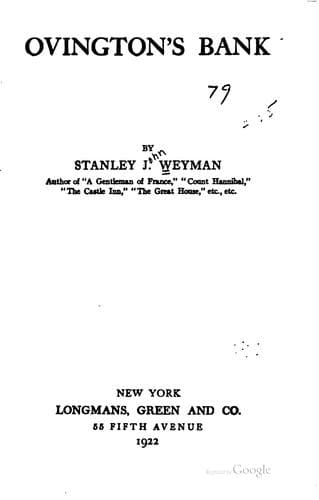
Banks and banking -- Fiction; England -- Social life and customs -- 19th century -- Fiction; Love stories
Their voices filled the bank, passed beyond it, were heard in the
street. Rodd worked on bravely, but the perspiration stood on his brow,
while the clerks, flurried and nervous, looked now at the clock and now
at the malcontents whose violence and restlessness seemed to treble
their numbers.
Then it was that Ovington came in, and on the instant the noise died
down, and there was silence. He advanced without speaking to within a
few feet of the counter. He was cold, composed, upright, dignified. And
still he did not speak. He surveyed his customers, his spectacles in
his hand. His eyes took in each. At length, “Gentlemen,” he said
quietly, “there is no need for this excitement. You will all be paid.
We are shorthanded to-day, but I had no reason to suppose that those
who know me as well as most of you do know me—and there are some here
who have known me all my life—would distrust me. However, as we are
shorthanded, the bank will remain open to-day until half-past four. Mr.
Rodd, you will see, if you please, that the requirements of those now
in the room are met. I need not add that the bank will open at the
usual time to-morrow. Good-day, gentlemen.”
They raised a feeble cheer in their relief, and in the act of turning
away, he paused. “Mr. Ricketts,” he said, singling out one, “you are
here about those bills? They are important. If you will bring them
through to me—yes, if you please?”
The man whom he had addressed, a banker’s clerk, followed him
thankfully into the parlor. His uneasiness had been great, for, though
he had not joined in his neighbors’ threats, his employers’ claim
exceeded those of all the rest put together.
“We daren’t wait, Mr. Ovington,” he said apologetically. “Our people
want it. I take it, it is all right, sir?”
“Quite,” Ovington said. “You have them here? What is the total?”
“Eighteen hundred and twenty-eight, six, eight, sir.”
Ovington examined the bills with a steady hand and wrote the amount on
a slip of paper. He rang the bell, and the younger clerk came in.
“Bring me that,” he said “as quickly as you can.” Then to his visitor,
“My compliments to Mr. Allwood. Will you tell him that his assistance
has been of material use to me, and that I shall not forget it? I was
sorry to hear of Gibbons’ failure.”
“Yes, sir. Very unfortunate. Very unfortunate, indeed?”
“He is no loser by them, I hope?”
“Well, he is, sir, I am sorry to say.”
“Ah, I am sorry.” And when the lad had brought in the money, and the
account was settled, “Are you returning to-night?”
“No, sir. My instructions were to travel by daylight.”
“Then you have an opportunity of stating outside, that you have been
paid? I am anxious, of course, to stop this foolish run.”
Public-domain text, read in full here on John Shaqi.
Reviews
Reviews
No reviews yet
Be the first to share your thoughts on this work.
Elsewhere in the archive
Join the Discussion
Join the discussion
Sign in to leave a comment or review.
Sign InorCreate an account