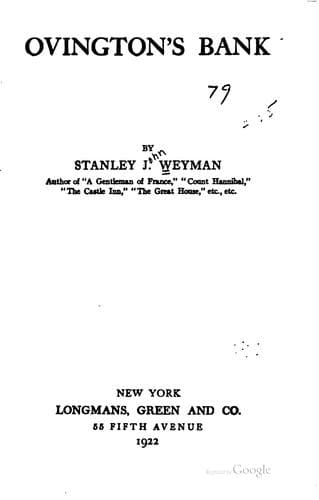
Banks and banking -- Fiction; England -- Social life and customs -- 19th century -- Fiction; Love stories
Probably of all those—and they were many—who travelled that day with
their faces set towards the bank, they were the last to start. If
Tuesday had been the town’s day, this was certainly the country’s day.
For one thing, there was a market; for another, the news of something
amiss, of something that threatened the little hoard of each—the
slowly-garnered deposit or the hardly-won note—had journeyed by this
time far and wide. It had reached alike the remote flannel-mill lapped
in the folds of the border-hills, and the secluded hamlet buried amid
orchards, and traceable on the landscape only by the grey tower of its
church. On foot and on horse-back, riding and tying, in gigs and
ass-carts, in market vans and carriers’ carts, the countryside came
in—all who had anything to lose, and many who had nothing at stake, but
were moved by a vague alarm. Even before daybreak the roads had begun
to echo the sound of their marching. They came by the East Bridge,
laboring up the steep, winding Cop; by the West Bridge and under the
gabled fronts of Maerdol, along the river bank, before the house of the
old sea-dog whose name was a household word, and whose portrait hung
behind the mayor’s chair, and so up the Foregate—from every quarter
they came. Before ten the streets were teeming with country-folk, whose
fears were not allayed by the news that all through the previous day
the townsfolk had been drawing their money. Sullen tradesmen, victims
of the general depression, eyed the march from their shop doors, and
some, fearing trouble, put up half their shutters. More took a
malicious amusement in telling the rustics that they were too late, and
that the bank would not open.
The alarm was heightened by a chance word which had fallen from
Frederick Welsh. The lawyer’s last thought had been to do harm, for his
interest in common with all substantial men lay the other way. But that
morning, before he had dressed, or so much as shaved, his office and
even his dining-room had been invaded. Scared clients had overwhelmed
him with questions—some that he could answer and more that he could
not. He could tell them the law as to their securities, whether they
were lodged for safety, or pawned for loans, or mortgaged on general
account. But he could not tell them whether Ovington was solvent, or
whether the bank would open, or whether Dean’s was affected; and it was
for answers to these questions that they clamored. In the end, badgered
out of all patience, he had delivered a curt lecture on banking.
Public-domain text, read in full here on John Shaqi.
Reviews
Reviews
No reviews yet
Be the first to share your thoughts on this work.
Elsewhere in the archive
Join the Discussion
Join the discussion
Sign in to leave a comment or review.
Sign InorCreate an account