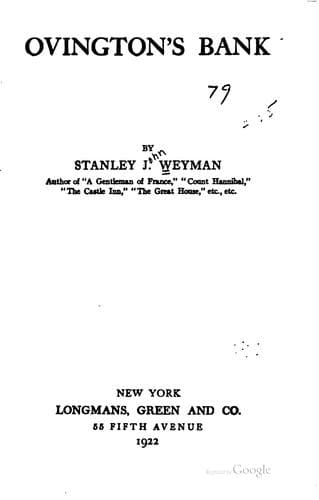
Banks and banking -- Fiction; England -- Social life and customs -- 19th century -- Fiction; Love stories
“Look here, gentlemen,” he had said, imposing silence from his
hearth-rug and pressing his points with wagging forefinger, “do you
know what happens when you pay a thousand pounds into a bank? No, you
don’t? Well, I’ll tell you. They put a hundred pounds into the till,
and they lend out four thousand pounds on the strength of the other
nine hundred. If they lend more than that, or lend that without
security, they go beyond legitimate banking. Now you know as much as I
do. A banker’s money is out on bills payable in two months or four,
it’s out on the security of shares and farms and shop-stock, it’s lent
on securities that cannot be realized in five minutes. But it’s all
there, mark me, somewhere, in something, gentlemen; and I tell you
candidly that it’s my opinion that if you would all go home and wait
for your money till you need it, you’d all get it in full, twenty
shillings in the pound.”
He meant no harm, but unfortunately the men who heard the lecture paid
no heed to the latter part, but went out, impressed with the former,
and spread it broad-cast. On which some cried, “That’s banking, is it!
Shameful, I call it!” while others said, “Well, I call it robbery! The
old tea-pot for me after this!” A few were for moving off at once and
breaking Ovington’s windows, and going on to Dean’s and serving them
the same. But they were restrained, things had not quite come to that;
and it was an orderly if excited throng that once more waited on Bride
Hill and in the Market Place for the opening of the doors.
Not all who gathered there had anything to lose. Many were mere
onlookers. But here and there were to be seen compressed lips, pale
faces, anxious eyes. Here and there women gripped books in feverish
fingers or squeezed handkerchiefs into tight balls; and now and again a
man broke into bad words and muttered what he would do if they robbed
him. There were country shopkeepers who had lodged the money to meet
the traveller’s account, and trembled for its safety. There were girls
who saw their hard-earned portions at stake, and parsons whose hearts
ached as they thought of the invalid wife or the boy’s school-bill; and
there were at least a score who knew that if the blow fell the bailiff,
never far from the threshold, would be in the house. Before the eyes of
not a few rose the spectres of the poorhouse and a pauper funeral.
Public-domain text, read in full here on John Shaqi.
Reviews
Reviews
No reviews yet
Be the first to share your thoughts on this work.
Elsewhere in the archive
Join the Discussion
Join the discussion
Sign in to leave a comment or review.
Sign InorCreate an account