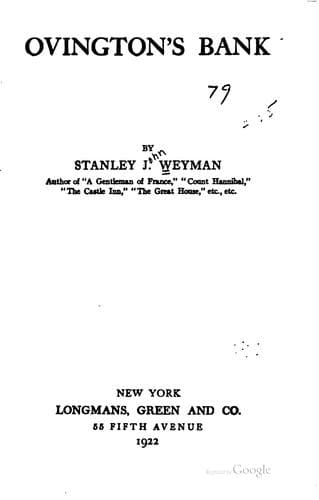
Banks and banking -- Fiction; England -- Social life and customs -- 19th century -- Fiction; Love stories
Standing in groups or dotted amid the crowd were bigger
men—wool-brokers and cattle-dealers—men loud in bar-parlors and great
among their fellows, whose rubicund faces showed flabby and mottled,
and whose fleshy lips moved in endless calculations. How was this bill
to be met, and who would renew that one? Too often the end of their
calculations spelled ruin—if the bank failed. Ruin—and many were they
who depended on these big men: wage-earners, clerks, creditors, poor
relations! One man walking up and down under the arcade of the Market
House was the centre for many eyes. He was an auctioneer from a
neighboring town, a man of wide dealings, who, it was whispered, had
lodged with Ovington’s the proceeds of his last great sale—a sum
running into thousands and due every penny to the vendor.
His case and other hard cases were whispered by one to another, and,
bruited about, they roused the passions even of those who were not
involved. Yet when the bank at length opened on the stroke of ten an
odd thing happened. A sigh, swelling to a murmur, rose from the dense
crowd, but no one moved. The expected came as the unexpected, there was
a moment of suspense, of waiting. No one advanced. Then some one raised
a shout and there was a rush for the entrance; men struggled and women
were thrust aside, smaller men were borne in on the arms of their
fellows. A wail rose from the unsuccessful, but no man heeded it, or
waited for his neighbor, or looked aside to see who it was who strove
and thrust and struggled at his elbow. They pushed in tumultuously,
their country boots drumming on the boards. Their entrance was like the
inrush of an invading army.
The clerks, the cashier, Ovington himself, stood at the counter waiting
motionless to receive them, confronting them with what courage they
might. But the strain of the preceding day had told. The clerks could
not conceal their misgivings, and even Rodd failed to bear himself with
the chilling air which had yesterday abashed the modest. He shot
vindictive glances across the counter, his will was still good to
wither, but the crowd was to-day made up of rougher material, was more
brusque and less subservient. They cared nothing for him, and he
looked, in spite of his efforts, weary and dispirited. There was no
longer any pretence that things were normal or that the bank was not
face to face with a crisis. The gloves were off. They were no longer
banker and customers. They were enemies.
It was Ovington himself who this morning stood forward, and in a few
cold words informed his friends that they would all be paid, requesting
them at the same time to be good enough to keep order and await their
turns, otherwise it would be impossible to proceed with the business.
He added a single sentence, in which he expressed his regret that those
who had known him so long should doubt, as he could only suppose that
they did doubt, his ability to meet his engagements.
Public-domain text, read in full here on John Shaqi.
Reviews
Reviews
No reviews yet
Be the first to share your thoughts on this work.
Elsewhere in the archive
Join the Discussion
Join the discussion
Sign in to leave a comment or review.
Sign InorCreate an account