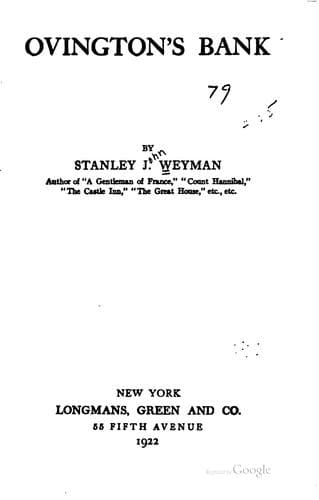
Banks and banking -- Fiction; England -- Social life and customs -- 19th century -- Fiction; Love stories
“They are doing more,” Ovington answered austerely—he no longer smiled.
“They are doing their best to ruin me, Sir Charles, and to plunge
themselves into loss. But I need not go into that. You are anxious
about the Railroad money? Very good.” He rang the bell and the clerk
came in. “Go to the strong-room,” the banker said, taking some keys
from the table, “with Mr. Clement, and bring me the box with the
Railway Trust.”
“I am sorry,” Sir Charles said, when they were alone, “to trouble you
at this time, but——”
Ovington stopped him. “You are perfectly in order,” he said. “Indeed, I
am glad you have come. The box will be here in a minute.”
Clement brought it in, and Ovington took another key and unlocked it.
“It is all here,” he explained, “except the small sum already expended
in preliminary costs—the sum passed, as you will remember, at the last
meeting of the Board. Here it is.” He took a paper which lay on the top
of the contents of the box. “Except four hundred and ten pounds, ten
shillings. The rest is invested in Treasury Bills until required. The
bills are here, and Clement will check them with you, Sir Charles,
while I finish this letter. We have, of course, treated this as a Trust
Fund, and I think that the better course will be for you to affix your
seal to the box when you have verified the contents.”
He turned to his letter, though it may be doubted whether he knew what
he was writing, while Sir Charles and Clement went through the box,
verified the securities, and finally sealed the box. That done,
Woosenham would have offered fresh apologies, but the banker waved them
aside and bowed him out, directing Clement to see him to the door.
That done, left alone once more, he sat thinking. The incident had
roused him and he felt the better for it. He had been able to assert
himself and he had confirmed in good will a man who might yet be of use
to him. But he was not left alone very long. Sir Charles had not been
gone five minutes before Rodd thrust a pale face in at the door, and in
an agitated whisper informed him that Owen and Jenkins were coming down
the High Street. A scout whom the cashier had sent out had seen them
and run ahead with the news. “They’ll be here in two minutes, sir,”
Rodd added in a tone which betrayed his dismay. “What am I to do? Will
you see them, sir?”
“Certainly,” Ovington answered. “Show them in as soon as they arrive.”
He spoke firmly, and made a brave show in Rodd’s eyes. But he knew that
up to this moment he had retained a grain of hope, a feeling, vague and
baseless, that something might yet happen, something might yet occur at
the last moment to save the bank. Well, it had not, and he must steel
himself to face the worst. The crisis had come and he must meet it like
a man. He rose from his chair and stood waiting, a little paler than
usual, but composed and master of himself.
Public-domain text, read in full here on John Shaqi.
Reviews
Reviews
No reviews yet
Be the first to share your thoughts on this work.
Elsewhere in the archive
Join the Discussion
Join the discussion
Sign in to leave a comment or review.
Sign InorCreate an account