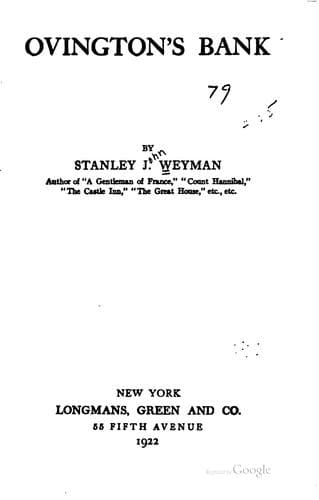
Banks and banking -- Fiction; England -- Social life and customs -- 19th century -- Fiction; Love stories
He heard the disturbance that the arrival of the two men caused in the
bank. Some one spoke in a harsh and peremptory tone, and something like
an altercation followed. Raised voices reached him, and Rodd’s answer,
civil and propitiatory, came, imperfectly, to his ear. The peremptory
voice rose anew, louder than before, and the banker’s face grew hard as
he listened. Did they think to browbeat him? Did they think to bully
him? If so, he would soon—but they were coming. He caught the sound of
the counter as Rodd raised it for the visitors to pass, and the advance
of feet, slowly moving across the floor. He fixed his eyes on the door,
all the manhood in him called up to meet the occasion.
The door was thrown open, widely open, but for a moment the banker
could not see who stood in the shadow of the doorway. Two men,
certainly, and Rodd at their elbow, hovering behind them; and they must
be Owen and Jenkins, though Rodd, to be sure, should have had the sense
to send in one at a time. Then it broke upon the banker that they were
not Owen and Jenkins. They were bigger men, differently dressed, of
another class; and he stared. For the taller of the two, advancing
slowly on the other’s arm, and feeling his way with his stick, was
Squire Griffin, and his companion was no other than Sir Charles,
mysteriously come back again.
Prepared for that which he had foreseen, Ovington was unprepared for
this, and the old man, still feeling on his unguarded side with his
stick, was the first to speak. “Give me a chair,” he grunted. “Is he
here, Woosenham?”
“Yes,” Woosenham said, “Mr. Ovington is here.”
“Then let me sit down.” And as Sir Charles let him down with care into
the chair which the astonished banker hastened to push forward, “Umph!”
he muttered, as he settled himself and uncovered his head. “Tell my
man”—this to Rodd—“to bring in that stuff when I send for it. Do you
hear? You there? Tell him to bring it in when I bid him.” Then he
turned himself to the banker, who all this time had not found a word to
say, and indeed had not a notion what was coming. He could only suppose
that the Squire had somehow revived Woosenham’s fears, in which case he
should certainly, Squire or no Squire, hear some home truths. “You’re
surprised to see me?” the old man said.
“Well, I am, Mr. Griffin. Yes.”
“Ay,” drily. “Well, I am surprised myself, if it comes to that. I
didn’t think to be ever in this room again. But here I am, none the
less. And come on business.”
The banker’s eyes grew hard. “If it is about the Railroad moneys,” he
said, “and Sir Charles is not satisfied——”
“It’s none of his business. Naught to do with the Railroad,” the Squire
answered. Then sharply, “Where’s my nephew? Is he here?”
“No, he is not at the bank to-day.”
Public-domain text, read in full here on John Shaqi.
Reviews
Reviews
No reviews yet
Be the first to share your thoughts on this work.
Elsewhere in the archive
Join the Discussion
Join the discussion
Sign in to leave a comment or review.
Sign InorCreate an account