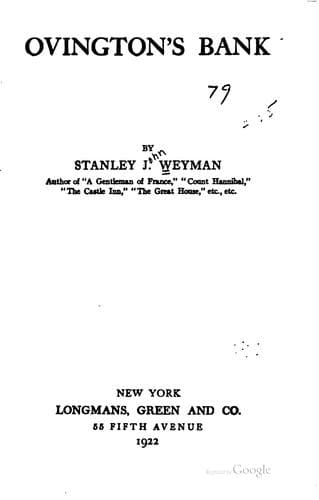
Banks and banking -- Fiction; England -- Social life and customs -- 19th century -- Fiction; Love stories
“No, father; she gave herself.”
“Well, there!” He freed himself from her. “That’s enough now, girl.
We’ll talk about it another time. But I’m not pleased, Betty.”
“No?” said Betty, gaily, but dabbing her eyes at the same time. “He
said that. He said that you would not be pleased. He was dreadfully
afraid of you. And I said you wouldn’t be pleased, too. But——”
“Eh?”
“I said you’d come to it, father, by and by. In good time.”
“Well, I’m——” But what the banker was, was lost in the peal of laughter
that Clement could no longer restrain.
CHAPTER XLI
Arthur, after he had dropped from the post-chaise that morning, did not
at once move away. He stood on the crown of the East Bridge, looking
down the river, and the turmoil of his feelings was such as for a time
to render thought of the future impossible, and even to hold despair at
bay. The certainty that his plan would have succeeded if it had not
been thwarted by the very persons who would have profited by it, and
the knowledge that but for their scruples all that he had at stake in
the bank would have been saved—this certainty and this knowledge, with
the fact that while they left him to bear the obloquy they had denied
him the prize, so maddened him that for a full minute he stood,
grasping the stone balustrade of the bridge, and whispering curses at
the current that flowed smoothly below.
The sunshine and the fair scene did but mock him. The green meadows,
and the winding river, and the crescent of stately buildings,
spire-crowned, that, curving with the stream, looked down upon it from
the site of the ancient walls, did but deride his misery. For, how many
a time had he stood on that spot and looked on that scene in days when
he had been happy and carefree, his future as sunny as the landscape
before him! And now—oh, the cowards! The cowards, who had not had the
courage even to pick up the fruit which his daring had shaken from the
bough.
Ay, his daring and his enterprise! For what else was it? What had he
done, after all, at which they need made mouths? It had been but a loan
he had taken, the use for a few weeks of money which was useless where
it lay, and of which not a penny would be lost! And again he cursed the
weakness of those who had rendered futile all that he, the bolder
spirit, had done, who had consigned themselves and him to failure and
to beggary. He had bought their safety at his own cost, and they had
declined to be saved. He shook with rage, with impotent rage, as he
thought of it.
Presently a man, passing over the bridge, looked curiously at him,
paused and went on again, and the incident recalled him to himself. He
remembered that he was in a place where all knew him, where his
movements and his looks would be observed, where every second person
who saw him would wonder why he was not at the bank. He must be going.
He composed his face and walked on.
Public-domain text, read in full here on John Shaqi.
Reviews
Reviews
No reviews yet
Be the first to share your thoughts on this work.
Elsewhere in the archive
Join the Discussion
Join the discussion
Sign in to leave a comment or review.
Sign InorCreate an account