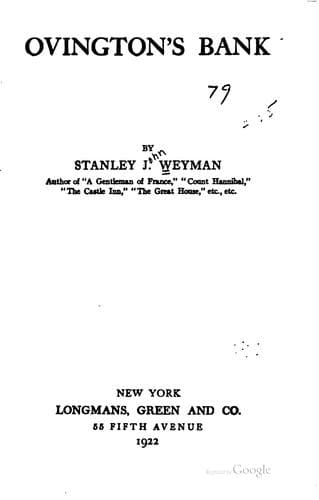
Banks and banking -- Fiction; England -- Social life and customs -- 19th century -- Fiction; Love stories
But whither? The question smote him with a strange and chilly sense of
loneliness. Whither? To the bank certainly, if he had courage, where
the battle was even now joined. He might fling himself into the fray,
play his part as if nothing had happened, smile with the best, ignore
what he had done and, if challenged, face it down. And there had been a
time when he could have done this. There had been a time, when Clement
had first alighted on him in town, when he had decided with himself to
play that rôle, and had believed that he could carry it off with a
smiling face. And now, now, as then, he maintained that he had done
nothing that the end did not justify, since the means could harm no
one.
But at that time he had believed that he could count on the complicity
of others, he had believed that they would at least accept the thing
that he had done and throw in their lot with his, and the failure of
that belief, brag as he might, affected him. It had sapped his faith in
his own standards. The view Clement had taken had slowly but surely
eclipsed his view, until now, when he must face the bank with a smile,
he could not muster up the smile. He began to see that he had committed
not a crime, but a blunder. He had been found out!
He walked more and more slowly, and when he came, some eighty yards
from the bridge and at the foot of the Cop, to a lane on his left which
led by an obscure shortcut to his rooms, he turned into it. He did not
tell himself that he was not going to the bank. He told himself that he
must change his clothes, and wash, and eat something before he could
face people. That was all.
He reached his lodgings, beneath the shadow of an old tower that looked
over the meadows to the river, without encountering any one. He even
stole upstairs, unseen by his landlady, and found the fire alight in
his sitting-room, and some part of a meal laid ready on the table. He
washed his hands and ate and drank, but instinctively, as he did so, he
hushed his movements and trod softly. When he had finished his meal he
stood for a moment, his eyes on the door, hesitating. Should he or
should he not go to the bank? He knew that he ought to go. But the wear
and tear of three days of labor and excitement, during which he had
hardly slept as many hours, had lowered his vitality and sapped his
will, and the effort required was now too much for him. With a sigh of
relief he threw up the sponge, he owned himself beaten. He sank into a
chair and, moody and inert, he sat gazing at the fire. He was very
weary, and presently his eyes closed, and he slept.
Two hours later his landlady discovered him, and the cry which she
uttered in her astonishment awoke him. “Mercy on us!” she exclaimed.
“You here, sir! And I never heard a sound, and no notion you were come!
But I was expecting you, Mr. Bourdillon. ‘He won’t be long,’ I says to
myself, ‘now that that plaguy bank’s gone and closed—worse luck to it!”
“Closed, has it?” he said, dully.
Public-domain text, read in full here on John Shaqi.
Reviews
Reviews
No reviews yet
Be the first to share your thoughts on this work.
Elsewhere in the archive
Join the Discussion
Join the discussion
Sign in to leave a comment or review.
Sign InorCreate an account