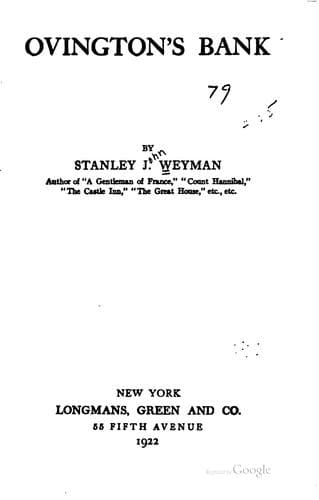
Banks and banking -- Fiction; England -- Social life and customs -- 19th century -- Fiction; Love stories
“Well, come in now, mother,” he said. He stooped and kissed her on the
forehead. He was very patient with her—let it be said to his credit.
“But, oh dear, dear!” She had lost control of herself and could not
stay her complaints if she would. “You would have your way! And you see
what has come of it! You would do it! And now—what am I to say to your
uncle?”
“You can leave him to me,” Arthur replied doggedly. “And for goodness’
sake, mother, come in and shut the door. You don’t want to talk to the
village, I suppose? Come in.”
He shepherded her into the parlor and closed the door on them. He was
cold, and he went to the fire and stooped over it, warming his hands at
the blaze.
“But the bank?”
“Oh, the bank’s gone,” he said.
She began to cry. “Then, I don’t know what’s to become of us!” she
sobbed. “It’s everything we have to live upon! And you know it wasn’t I
signed the order to—to your uncle! I never did—it was you—wrote my
name. And now—it has ruined us! Ruined us!”
His face grew darker. “If you wish to ruin us,” he said, “at any rate
if you wish to ruin me, you’ll talk like that! As it is, you’ll not
lose your money, or only a part of it. The bank can pay everyone, and
there’ll be something over. A good deal, I fancy,” putting the best
face on it. “You’ll get back the greater part of it.” Then, changing
the subject abruptly, “What did Clement Ovington want?”
“I don’t—know,” she sobbed. But already his influence was mastering
her; already she was a little comforted. “He asked for you. I didn’t
see him—I could not bear it. I suppose he came to—to tell me about the
bank.”
“Well,” ungraciously, “he might have spared himself the trouble.” And
under his breath he added a curse. “Now let me have some tea, mother.
I’m tired—dog tired. I had no sleep last night. And I want to see Pugh
before he goes. He must take a note for me—to Garth.”
“I’m afraid the Squire——”
“Oh, hang the Squire! It’s not to him,” impatiently. “It’s to Josina,
if you must know.”
She perked up a little at that—she had always some hope of Josina; and
the return to everyday life, the clatter of the tray as it was brought
in, the act of giving him his tea and seeing that he had what he liked,
the mere bustling about him, did more to restore her. The lighted room,
the blazing fire, the cheerful board—in face of these things it was
hard to believe in ruin, or to fancy that life would not be always as
it had been. She began again to have faith in him.
Public-domain text, read in full here on John Shaqi.
Reviews
Reviews
No reviews yet
Be the first to share your thoughts on this work.
Elsewhere in the archive
Join the Discussion
Join the discussion
Sign in to leave a comment or review.
Sign InorCreate an account