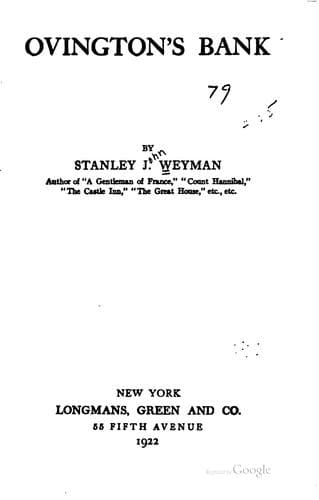
Banks and banking -- Fiction; England -- Social life and customs -- 19th century -- Fiction; Love stories
And he, whose natural bent it was to be sanguine, whose spirits had
already rebounded from the worst, shared the feeling which he imparted.
That she knew the worst was something; that, at any rate, was over, and
confidently, he began to build his house again. “You won’t lose,” he
said, casting back the locks from his forehead with the gesture
peculiar to him. “Or not more than a few hundreds at worst, mother.
That will be all right. I’ll see to that. And my uncle—you may leave
him to me. He’s been vexed with me before, and I’ve brought him round.
Oh, I know him. I’ve no doubt that I can manage him.”
“But Josina?” timidly. “D’you know, she was terribly low, Arthur—about
something yesterday. She wouldn’t tell me, but there was something. She
didn’t seem to want to talk about you.”
He winced, and for a moment his face fell. But he recovered himself,
and, “Oh, I’ll soon put that right,” he answered confidently. “I shall
see her in the morning. She’s a good soul, is Josina. I can count on
her. Don’t you fret, mother. You’ll see it will all come right—with a
little management.”
“Well, I know you’re very clever, Arthur. But Jos——”
“Jos is afraid of him, that’s all.” And laughing, “Oh, I’ve an arrow in
my quiver, yet, mother. We shall see. But I must see Jos in the
morning. Is Pugh there? I’ll write to her now and ask her to meet me at
the stile at ten o’clock. Nothing like striking while the iron is hot.”
On the morrow he did not feel quite so confident. The sunshine and open
weather of the day before had given place to rain and fog, and when,
after crossing the plank-bridge at the foot of the garden, he took the
field path which led to Garth, mist hid the more distant hills, and
even the limestone ridge which rose to her knees. The vale had ceased
to be a vale, and he walked in a plain, sad and circumscribed, bounded
by ghostly hedges, which in their turn melted into grey space. That the
day should affect his spirits was natural, and that his position should
appear less hopeful was natural, too, and he told himself so, and
strove to rally his courage. He strode along, swinging his stick and
swaggering, though there was no one to see him. And from time to time
he whistled to prove that he was free from care.
After all, the fact that it rained did not alter matters. Wet or dry he
had saved the Squire’s life, and a man’s life was his first and last
and greatest possession, and not least valued when near its end. He who
saved it had a claim, and much—much must be forgiven him. Then, too, he
reminded himself that the old man was no longer the hard, immovable
block that he had been. The loss of sight had weakened him; he had
broken a good deal in the last few months. He could be cajoled,
persuaded, made to see things, and surely, with Josina’s help, it would
not be impossible to put such a color on the—the loan of the securities
as might make it appear a trifle. Courage! A little courage and all
would be well yet.
Public-domain text, read in full here on John Shaqi.
Reviews
Reviews
No reviews yet
Be the first to share your thoughts on this work.
Elsewhere in the archive
Join the Discussion
Join the discussion
Sign in to leave a comment or review.
Sign InorCreate an account