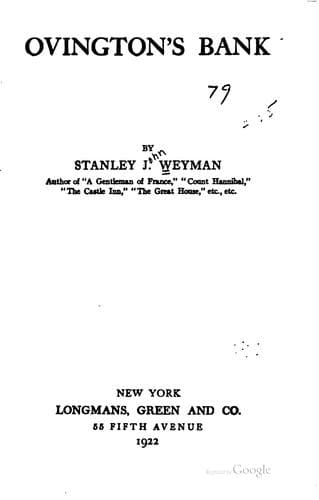
Banks and banking -- Fiction; England -- Social life and customs -- 19th century -- Fiction; Love stories
Now, if he gave way, what would they say? What laughter would there not
be from one end of the county to the other, what sneers, what talk of
an old man’s folly and an old man’s weakness! For it was not even as if
the man’s father had been a Peel or the like, a Baring or a Smith! A
small country banker, a man just risen from the mud—not even a stranger
from a distance, or a merchant prince from God knows where! Oh, it was
impossible. Impossible! Garth, that had been in the hands of
gentlefolk, of Armigeri from Harry the Eighth, to pass into the hands,
into the blood of—no, it was impossible! All the world of Aldshire
would jeer at it, or be scandalized by it.
“I wun’t do it!” said the Squire for the hundredth time. It was more
particularly at the thought of Acherley that he squirmed. He despised
Acherley, and to be despised by Acherley—that was too much!
“Of course,” said a small voice within him, “he would take the name of
Griffin, and in time——”
“Mud’s mud,” replied the Squire silently. “You can’t change it.”
“But he’s honest,” quoth the small voice.
“So’s Calamy!”
“He saved——”
“And I ha’ paid him! Damme, I ha’ paid him! Ha’ done!” And then, “It’s
that blow on the head has moithered me!”
Things went on in this way for a month, the Squire renewing his vigor
and beginning to tramp his fields again, or with the new man at his
bridle-hand to ride the old grey from point to point, learning what the
men were doing, inquiring after gaps, and following the manure to the
clover-ley, where the oats and barley would presently go in. Snow lay
on the upper hills, grizzling the brown sheets of bracken, and dappling
the green velvet of the sloping ling; the valley below was frost-bound.
But the Squire had a fire within him, a fire of warring elements, that
kept his blood running. He was very sharp with the men and scolded old
Fewtrell. As for Thomas’s successor, the lad learned to go warily and
kept his tongue between his teeth.
The girl had never complained; it seemed as if that which he had done
for her had silenced her, as if, she, too, had taken it for payment.
But one day she was not at table, and Miss Peacock cut up his meat. She
did not do it to his mind—no hand but Jos’s could do it to his mind—and
he was querulous and dissatisfied.
“I’m sure it’s small enough, sir,” Miss Peacock answered, feebly
defending herself. “You said you liked it small, Mr. Griffin.”
“I never said I liked mince-meat! Where is the girl? What ails her?”
“It’s nothing, sir. She’s been looking a little peaky the last week or
two. That’s all. And to-day——”
“Why didn’t you tell me?”
“It’s only a headache, sir. She’ll be well enough when the spring
comes. Josina was always nesh—like her mother.”
Public-domain text, read in full here on John Shaqi.
Reviews
Reviews
No reviews yet
Be the first to share your thoughts on this work.
Elsewhere in the archive
Join the Discussion
Join the discussion
Sign in to leave a comment or review.
Sign InorCreate an account