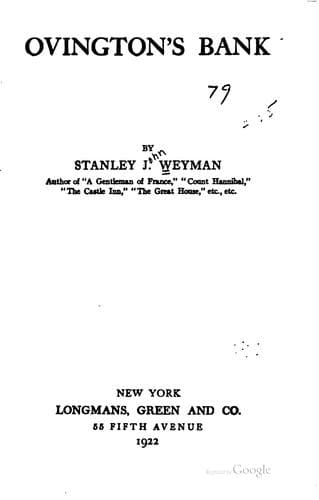
Banks and banking -- Fiction; England -- Social life and customs -- 19th century -- Fiction; Love stories
“Not in my time, by G—d!” he muttered, his knees quivering a little
under him—for he was an aging man and the scene had tried him. “Not in
my time!” And at the thought that he, the owner of all, hill and vale,
within his sight, and the descendant of generations of owners—that he
had been threatened by this upstart, this loan-monger, this town-bred
creature of a day, he swore with fresh vigor.
He had at any rate the fires of indignation to warm him, and the
satisfaction of knowing that he had spoken his mind and had not had the
worst of the bout. But the banker’s feelings as he jogged homewards on
his hackney were not so happy. In spite of Bourdillon’s warning he had
been confident that he would gain his end. He had fancied that he knew
his man and could manage him. He had believed that the golden lure
would not fail. But it had failed, and the old man’s gibes accompanied
him, and like barbed arrows clung to his memory and poisoned his
content.
It was not the worst that he must return and own that Arthur had been
wiser than he; that he must inform his colleagues that his embassy had
failed. Worse than either was the hurt to his pride. Certain things
that the Squire had said about money-making, his sneer about the
difference in breeding, his warning that the banker might yet find that
he had been too clever—these had pricked him to the quick, and the last
had even caused him a pang of uneasiness. And then the Squire had shown
so clearly the gulf that in his eyes lay between them!
Ay, it was that which rankled: the knowledge, sharply brought home to
him, that no matter what his success, no matter what his wealth, nor
how the common herd bowed down to him, this man and his like would ever
hold themselves above him, would always look down on him. The fence
about them he could not cross. Add thousands to thousands as he might,
and though he conquered Lombard Street, these men would not admit him
of their number. They would ever hold him at arm’s length, would deal
out to him a cold politeness. He could never be of them.
As a rule Ovington was too big a man to harbor spite, but as he rode
and fumed, a plan which he had already considered put on a new aspect,
and by and by his brow relaxed and he smote his thigh. Something
tickled him and he laughed. He thought that he saw a way to avenge
himself and to annoy his enemy, and by the time he reached the bank he
was himself again. Indeed, he had not been human if he had not by that
time owned that whatever Garth thought of him he was something in
Aldersbury.
Three times men stopped him, one crossing the street to intercept him,
one running bare-headed from a shop, a third seizing his rein. And all
three sought favors, or craved advice, all, as they retreated, did so,
eyed askance by those who lacked their courage or their impudence.
Public-domain text, read in full here on John Shaqi.
Reviews
Reviews
No reviews yet
Be the first to share your thoughts on this work.
Join the Discussion
Join the discussion
Sign in to leave a comment or review.
Sign InorCreate an account