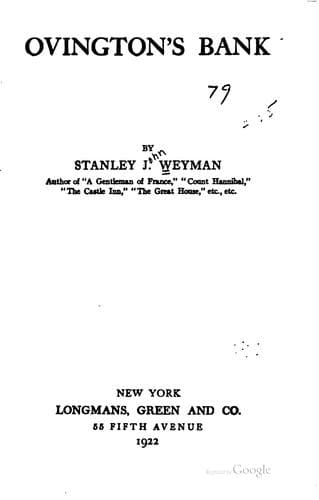
Banks and banking -- Fiction; England -- Social life and customs -- 19th century -- Fiction; Love stories
“D——n!” muttered the other, nodding right and left. “Too bad of the
boy! Too bad! No,” to the person who had lain in wait for Bourdillon
and now put himself in their way, “I can’t stop now, Mr. Broadway.”
“But, Mr. Ovington! Just a——”
“Not now!” Ovington answered curtly. “Call to-morrow.” And when they
had left the man behind, “What does he want?”
“What they all want,” Arthur answered, smiling. “A good thing, sir.”
“But he isn’t a customer.”
“No, but he will be to-morrow,” the young man rejoined. “They are all
agog. They’ve got it that you can make a man’s fortune by a word, and
of course they want their fortunes made.”
“Ah!” the other ejaculated drily. “But seriously, look about you,
Arthur. Did you ever see a greater change in men’s faces—from what they
were this time two years? Even the farmers!”
“Well, they are doing well.”
“Better, at any rate. Better, even they. Yes, Mr. Wolley,” to a stout
man, much wrapped up, who put himself in the way, “follow us, please.
Sir Charles is waiting. Better,” Ovington continued to his companion,
as the man fell behind, “and prices rising, and demand—demand spreading
in everything.”
“Including Stocks?”
“Including Stocks. I’ve some news for Sir Charles, that, if he has any
doubts about joining us, will fix him. Well, here we are, and I’m glad
to be at home. We’ll go in by the house door, Arthur, or Betty will be
disappointed.”
The bank stood on Bride Hill, looking along the High Street. The
position was excellent and the house good. Still, it was no more than a
house, for in 1825 banks were not the institutions that they have since
become; they had still for rivals the old stocking and the cracked
teapot, and among banks, Ovington’s at Aldersbury was neither of long
standing nor of more than local repute.
Mr. Ovington led the way into the house, and had barely removed his hat
when a girl flew down the wide oak staircase and flung herself upon
him. “Oh, father!” she cried. “Here at last! Aren’t you cold? Aren’t
you starving?”
“Pretty well for that,” he replied, stroking her hair in a way that
proved that, whatever he was to others, he had a soft spot for his
daughter. “Pretty well for that, Betty.”
“Well, there’s a good fire! Come and warm yourself!”
“That’s what I can’t do, my dear,” he said, taking off his great coat.
“Business first.”
“But I thought you had done all that in London?” pouting.
“Not all, but some. I shall be an hour, perhaps more.”
She shot a mutinous glance at Arthur. “Why can’t he do it? And Mr.
Rodd?”
“You think we are old enough, Betty?”
“Apprentices should be seen, and not heard!” she snapped.
Arthur’s position at the bank had been hardly understood at first, and
in some fit of mischief, Betty, determined not to bow down to his
pretensions, had christened him the “Apprentice.”
“I thought that that proverb applied to children,” he retorted.
Public-domain text, read in full here on John Shaqi.
Reviews
Reviews
No reviews yet
Be the first to share your thoughts on this work.
Join the Discussion
Join the discussion
Sign in to leave a comment or review.
Sign InorCreate an account