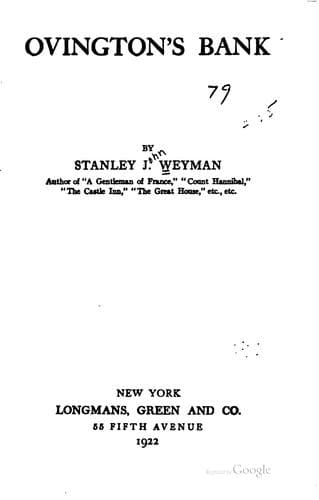
Banks and banking -- Fiction; England -- Social life and customs -- 19th century -- Fiction; Love stories
“Not now. But I shall not go on. What——” Her eyes strayed to the wood,
and curiosity stirred in her. “What were you looking at so intently,
Mr. Ovington, that you did not hear me?”
He colored. “Oh, nothing!”
“But it must have been something!” Her curiosity was strengthened.
“Well, if you wish to know,” he confessed, shamefacedly, “I was looking
at those snowdrops.”
“Those snowdrops?”
“Don’t you see how the sunlight touches them? What a little island of
light they make among the brown leaves?”
“How odd!” She stared at the snowdrops and then at him. “I thought that
only painters and poets, Mr. Wordsworth and people like that, noticed
those things. But perhaps you are a poet?”
“Goodness, no!” he cried. “A poet? But I am fond of looking at
things—out of doors, you know. A little way back”—he pointed up-stream,
the way he had come—“I saw a rat sitting on a lily leaf, cleaning its
whiskers in the sun—the prettiest thing you ever saw. And an old man
working at Bache’s told me that he—but Lord, I beg your pardon! How can
I talk of such things when I remember——?”
He stopped, overcome by the recollection of that through which they had
passed. She, for her part, was inclined to ask him to go on, but
remembered that this, all this was very irregular. What would her
father say? And Miss Peacock? Yet, if this was irregular, so was the
adventure itself. She would never forget his face of horror, the appeal
in his eyes, his poignant anxiety. No, it was impossible to act as if
nothing had happened between them, impossible to be stiff and to talk
at arm’s length about prunes and prisms with a person who had all but
taken her life—and who was so very penitent. And then it was all so
interesting, so out of the common, so like the things that happened in
books, like that dreadful fall from the Cobb at Lyme in “Persuasion.”
And he was not ordinary, not like other people. He looked at snowdrops!
But she must not linger now. Later, when she was alone in her room, she
could piece it together and make a whole of it, and think of it, and
compass the full wonder of the adventure. But she must go now. She told
him so, the primness in her tone reflecting her thoughts. “Will you
kindly give me the basket?”
“I am going to carry it,” he said. “You must not go alone. Indeed you
must not, Miss Griffin. You may feel it more by and by. You may—go off
suddenly.”
“Oh,” she replied, smiling, “I shall not go off, as you call it, now.”
“I will only come as far as the mill,” humbly. “Please let me do that.”
She could not say no, it could hardly be expected of her; and she
turned with him. “I shall never forgive myself,” he repeated. “Never!
Never! I shall dream of the moment when I lost sight of you in the
smoke and thought that I had killed you. It was horrible! Horrible! It
will come back to me often.”
Public-domain text, read in full here on John Shaqi.
Reviews
Reviews
No reviews yet
Be the first to share your thoughts on this work.
Join the Discussion
Join the discussion
Sign in to leave a comment or review.
Sign InorCreate an account