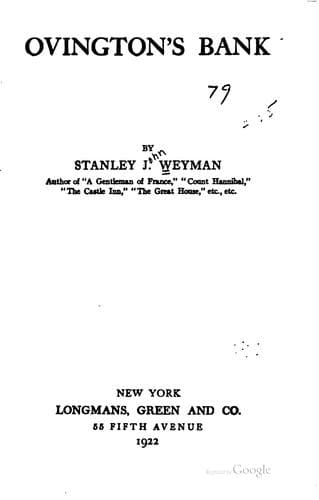
Banks and banking -- Fiction; England -- Social life and customs -- 19th century -- Fiction; Love stories
But he would not be dashed. “To make two blades of grass grow where one
grew before,” he answered stoutly, though he knew that he had sunk in
her eyes. “Just that; but after all isn’t that worth doing? Isn’t that
better than burying your head in a ledger and counting other folk’s
money while the sun shines out of doors, and the rain falls sweetly,
and the earth smells fresh and pure? Besides, it is all I am good for,
Miss Griffin. I do think I understand a bit about that. I’ve read books
about it and I’ve kept my eyes open, and—and what one likes one does
well, you know.”
“But farmers——”
“Oh, I know,” sorrowfully, “it must seem a very low thing to you.”
“Farmers don’t look at snowdrops, Mr. Ovington,” with a gleam of fun in
her eyes.
“Don’t they? Then they ought to, and they’d learn a lot that they don’t
know now. I’ve met men, laboring men who can’t read or write, and it’s
wonderful the things they know about the land and the way plants grow
on it, and the live things that are only seen at night, or stealing to
their homes at daybreak. And there’s a new wheat, a wheat I was reading
about yesterday, Cobbett’s corn, it is called, that I am sure would do
about here if anyone would try it. But there,” remembering himself and
to whom he was talking, “this can have no interest for you. Only
wouldn’t you rather plod home weary at night, feeling that you had done
something, and with all this”—he waved his hand—“sinking to rest about
you, and the horses going down to water, and the cattle lowing to be
let into the byres, and—and all that,” growing confused, as he felt her
eyes upon him, “than get up from a set of ledgers with your head aching
and your eyes muddled with figures?”
“I’m afraid I have not tried either,” she said. But she smiled. She
found him new, his notions unlike those of the people about her, and
certainly unlike those of a common farmer. She did not comprehend all
his half-expressed thoughts, but not for that was she the less resolved
to remember them, and to think of them at her leisure. For the present
here was the mill, and they must part. At the mill the field-path which
they were following fell into a lane, which on the right rose steeply
to the road, on the left crossed a cart-bridge, shaken perpetually by
the roar and wet with the spray of the great mill-wheel. Thence it
wound upwards, rough and stony, to the back premises of Garth.
He, too, knew that this division of the ways meant parting, and
humility clothed him. “Heavens, what a fool I’ve been,” he said,
blushing, as he met her eyes. “What must you think of me, prating about
myself when I ought to have been thinking only of you and asking your
pardon.”
“For nearly shooting me?”
“Yes—and thank God, thank God,” with emotion, “that it was not worse.”
“I do.”
“I ought never to carry a gun again!”
“I won’t exact that penalty.” She looked at him very kindly.
“And you will forgive me? You will do your best to forgive me?”
Public-domain text, read in full here on John Shaqi.
Reviews
Reviews
No reviews yet
Be the first to share your thoughts on this work.
Join the Discussion
Join the discussion
Sign in to leave a comment or review.
Sign InorCreate an account