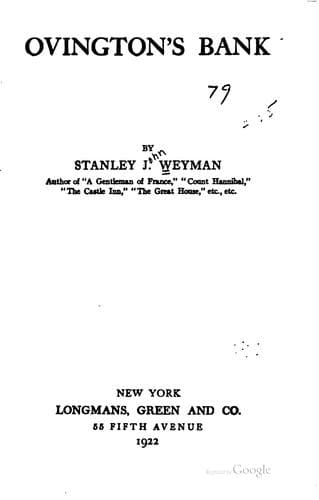
Banks and banking -- Fiction; England -- Social life and customs -- 19th century -- Fiction; Love stories
Sir Charles adjusted his glasses, and frowned at the paper. He was
prepared to be displeased and to show it. “Two thousand six hundred,”
he muttered, “two thousand six hundred and twenty-seven!” his jaw
dropping in his surprise. “Two thousand six—really! Ah, well, I
certainly think—” with a quick change to cordiality that would have
amused an onlooker—“that you acted for the best. I am obliged to you,
much obliged, Mr. Ovington. A handsome profit.”
“I felt sure that you would approve,” the banker assented gravely.
“Shall Bourdillon put the draft—Arthur, be good enough to place this
draft to Sir Charles Woosenham’s account. And tell Mr. Wolley and Mr.
Grounds—I think they are waiting—to come in. I ask your pardon, Mr.
Acherley,” approaching him in turn.
“No plum for me, I suppose?” growled that gentleman, whom the gist of
the interview with Sir Charles had not escaped. He was a tall,
hatchet-faced, dissipated-looking man, of an old family, Acherley of
Acherley. He had been a dandy with Brummell, had shaken his elbow at
Watier’s when Crockford managed it, had dined at the Pavilion; now he
vegetated in the country on a mortgaged estate, and on Sundays attended
cock-fights behind the village public-house.
“Well, not to-day,” Ovington answered pleasantly. “But when we have
shaken the tree a little——”
“One may fall, you think?”
“I hope so. You will be unlucky if one does not.”
The two men who had been summoned came in, each after his fashion.
Wolley entered first, endeavoring to mask under a swaggering manner his
consciousness that he stood in the presence of his betters. A clothier
from the Valleys and one of Ovington’s earliest customers, he had
raised himself, as the banker had, and from the same stratum; but by
enlarging instead of selling his mill. During the war he had made much
money and had come to attribute his success a little more to his
abilities and a little less to circumstances than was the fact. Of late
there were whispers that in the financial storm of ’16, which had
followed the close of the war, he had come near the rocks; but if so he
had put a bold face on the crisis, and by steadily putting himself
forward he had impressed most men with a belief in his wealth.
“Afternoon, Sir Charles,” he grunted with as much ease as he could
compass. “Afternoon,” to Acherley. He took a seat at the table and
slapped down his hat. He was here on business and he meant to show that
he knew what business was.
Public-domain text, read in full here on John Shaqi.
Reviews
Reviews
No reviews yet
Be the first to share your thoughts on this work.
Join the Discussion
Join the discussion
Sign in to leave a comment or review.
Sign InorCreate an account