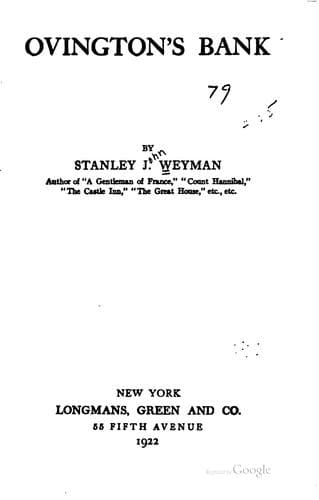
Banks and banking -- Fiction; England -- Social life and customs -- 19th century -- Fiction; Love stories
Spring was late that year. It was the third week in April before the
last streak of snow faded from the hills, or the showers of sleet
ceased to starve the land. Morning after morning the Squire tapped his
glass and looked abroad for fine weather. The barley-sowing might wait,
but the oats would not wait, and at a time when there should have been
abundant grass he was still carrying hay to the racks. The lambs were
doing ill.
Morning after morning, with an old caped driving-coat cast about his
shoulders and a shabby hunting-cap on his grey head, he would walk down
to the little bridge that carried the drive over the stream. There, a
gaunt high-shouldered figure, he would stand, looking morosely out over
the wet fields. The distant hills were clothed in mist, the nearer
heights wore light caps, down the vale the clear rain-soaked air showed
sombre woods and red soil, with here and there a lop-sided elm,
bursting into bud, and reddening to match the furrows. “We shall lose
one in ten of the lambs,” he thought, “and not a sound foot in the
flock!”
One morning as he stood there he saw a man turn off the road and come
shambling towards him. It was Pugh, the man-of-all-work at the Cottage,
and in his disgust at things in general, the Squire cursed him for a
lazy rascal. “I suppose they’ve nothing to do,” he growled, “that they
send the rogue traipsing the roads at this hour!” Aloud, “What do you
want, my man?” he asked.
Pugh quaked under the Squire’s hard eyes. “A letter from the mistress,
your honor.”
“Any answer?”
Reluctantly Pugh gave up the hope of beer with Calamy the butler. “I’d
no orders to wait, sir.”
“Then off you go! I’ve all the idlers here I want, my lad.”
The Squire had not his glasses with him, and he turned the letter over
to no purpose. Returning to his room he could not find them, and the
delay aggravated a temper already oppressed by the weather. He shouted
for his spectacles, and when Miss Peacock, hurrying nervously to his
aid, suggested that they might be in the Prayer Book from which he had
read the psalm that morning, he called her a fool. Eventually, it was
there that they were found, on which he dismissed her with a flea in
her ear. “If you knew they were there, why did you leave them there!”
he stormed. “Silly fools women be!”
But when he had read the letter, he neither stormed nor swore. His
anger was too deep. Here was folly, indeed, and worse than folly,
ingratitude! After all these years, after forty years, during which he
had paid them their five per cent. to the day, five per cent. secured
as money could not be secured in these harum-scarum days—to demand
their pound of flesh and to demand it in this fashion! Without warning,
without consulting him, the head of the family! It was enough to make
any man swear, and presently he did swear after the manner of the day.
Public-domain text, read in full here on John Shaqi.
Reviews
Reviews
No reviews yet
Be the first to share your thoughts on this work.
Join the Discussion
Join the discussion
Sign in to leave a comment or review.
Sign InorCreate an account