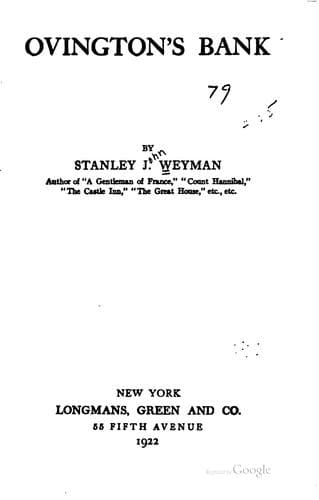
Banks and banking -- Fiction; England -- Social life and customs -- 19th century -- Fiction; Love stories
He could go to the bank afterwards, but he might not have complied so
readily if his vanity had not been tickled. The Justices of that day
bore a heavier burden than their successors—_hodie nominis umbrae_.
With no police force they had to take the initiative in the detection
as well as in the punishment of crime. Marked men, belonging to a
privileged class, they had to do invidious things and to enforce
obnoxious laws. They represented the executive, and they shared alike
its odium and its fearlessness. For hardly anything is more remarkable
in the history of that time than the courage of the men who held the
reins. Unpopular, assailed by sedition, undermined by conspiracy, and
pressed upon by an ever-growing public feeling, the few held on
unblenching, firm in the belief that repression was the only policy,
and doubting nothing less than their right to rule. They dined and
drank, and presented a smiling face to the world, but great and small
they ran their risks, and that they did not go unscathed, the fate of
Perceval and of Castlereagh, the collapse of Liverpool, and the
shortened lives of many a lesser man gave proof.
But even among the firm there are degrees, and in all bodies it is on
the shoulders of one or two that the onus falls. Of the one or two in
Aldshire, the Squire was one. My lord might fill the chair, Sir Charles
might assent, but it was to Griffin that their eyes wandered when an
unpleasant decision had to be taken or the public showed its teeth. And
the old man knew that this was so, and was proud of it.
To-day, however, as he watched the long hand move round the clock, he
had less patience than usual. Because he must be at the bank before it
closed, everything seemed to work against him. The witnesses were
sullen, the evidence dragged, Acherley went off on a false scent, and
being whipped back, turned crusty. The Squire fidgeted and scowled, and
then, twenty minutes before the bank closed, and when with his eyes on
the clock he was growing desperate, the chairman suggested that they
should break off for a quarter of an hour. “Confound me, if I can sit
any longer,” he said. “I must have a mouthful of something, Griffin.”
The Squire seldom took more than a hunch of bread at mid-day and could
do without that, but he was glad to agree, and a minute later he was
crossing the Market Place towards the bank. It happened that business
was brisk at the moment. Rodd, at a side desk, was showing a customer
how to draw a cheque. At the main counter a knot of farmers were
producing, with protruding tongues and hunched shoulders, something
which might pass for a signature. Two clerks were aiding them, and for
a moment the Squire stood unseen and unregarded. Impatiently he tapped
the counter with his stick, on which Rodd saw him, and, deserting his
task, came hurriedly to him.
The Squire thrust his cheque across the counter. “In gold,” he said.
Public-domain text, read in full here on John Shaqi.
Reviews
Reviews
No reviews yet
Be the first to share your thoughts on this work.
Elsewhere in the archive
Join the Discussion
Join the discussion
Sign in to leave a comment or review.
Sign InorCreate an account