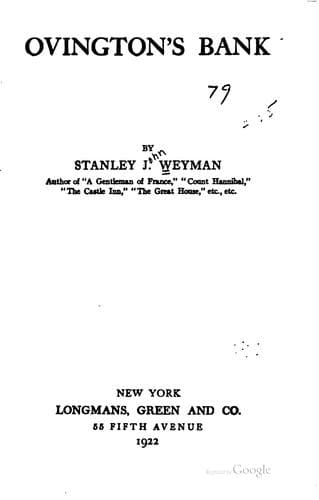
Banks and banking -- Fiction; England -- Social life and customs -- 19th century -- Fiction; Love stories
The cashier scanned the cheque, his hand in the till. “Four, seven,
six-ten,” he murmured. Then his face grew serious, and without glancing
at the Squire he consulted a book which lay beside him. “Four, seven,
six-ten,” he repeated. “I am afraid—one moment, if you please, sir!”
Breaking off he made two steps to a door behind him and disappeared
through it.
He returned a moment later, followed by Ovington himself. The banker’s
face was grave, but his tone retained its usual blandness. “Good day,
Mr. Griffin,” he said. “You are drawing the whole of your balance, I
see. I trust that that does not mean that you are—making any change?”
“That is what it does mean, sir,” the Squire answered.
“Of course, it is entirely your affair——”
“Entirely.”
“But we are most anxious to accommodate you. If there is anything that
we can put right, any cause of dissatisfaction——”
“No,” said the Squire grimly. “There is nothing that you can put right.
It is only that I do not choose to do business with my family.”
The banker bowed with dignity. The incident was not altogether
unexpected. “With most people, a connection of the kind would be in our
favor,” he said.
“Not with me. And as my time is short——”
The banker bowed. “In gold, I think? May we not send it for you? It
will be no trouble.”
“No, I thank you,” the Squire grunted, hating the other for his
courtesy. “I will take it, if you please.”
“Put it in a strong bag, Mr. Rodd,” Ovington said. “I shall still hope,
Mr. Griffin, that you will think better of it.” And, bowing, he wished
the Squire “Good day,” and retired.
Rodd was a first-class cashier, but he felt the Squire eyes boring into
him, and he was twice as long in counting out the gold as he should
have been. The consequence was that when the Squire left the bank, the
hour had struck, Dean’s was closed, and the Bench was waiting for him.
He paused on the steps considering what he should do. He could not
leave so large a sum unguarded in the Justices’ room, nor could he
conveniently take it with him into the Court.
At that moment his eyes fell on Purslow, the draper, who was standing
at the door of his shop, and he crossed over to him. “Here, man, put
this in your safe and turn the key on it,” he said. “I shall call for
it in an hour or two.”
“Honored, I am sure,” said the gratified tradesman, as he took the bag.
But when he felt its weight and guessed what was in it, “Excuse me,
sir. Hadn’t you better seal it, sir?” he said. “It seems to be a large
sum.”
“No need. I shall call for it in an hour. Lock it up yourself, Purslow.
That’s all.”
Purslow, as pleased as if the Squire had given him a large order,
assured him that he would do so, and the old man stalked across to the
court, where business kept him, fidgeting and impatient, until hard on
seven. Nor did he get away then without unpleasantness.
Public-domain text, read in full here on John Shaqi.
Reviews
Reviews
No reviews yet
Be the first to share your thoughts on this work.
Elsewhere in the archive
Join the Discussion
Join the discussion
Sign in to leave a comment or review.
Sign InorCreate an account