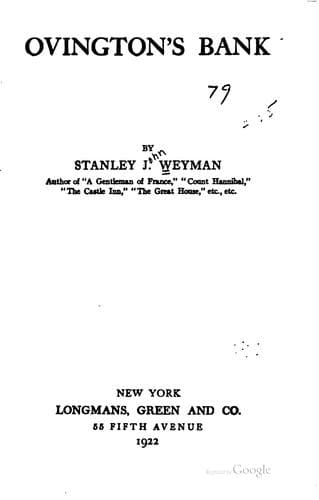
Banks and banking -- Fiction; England -- Social life and customs -- 19th century -- Fiction; Love stories
For a time after the Squire had driven away, Clement had sat his horse
and stared after him, and in his rage had wished him dead. He had
prepared himself for opposition, he had looked to be repulsed—he had
expected nothing else. But in the scene which his fancy had pictured,
his part had been one of dignity; he had owned his aspirations like a
man, he had admitted his insufficiency with modesty, he had pleaded the
power of love with eloquence, he had won even from the Squire a meed of
unwilling approbation.
But the scene, as played, had run on other lines. The old man had
crushed him. He had sworn at him, refused to listen to him, had
insulted him, had treated him as no better than a shop-boy. And all
this had cut to the quick. For Clement, born after Ovington had risen
from the ranks, had his pride and his self-respect, and humiliated, he
cursed with all his soul the prejudice and hide-bound narrowness of the
Squire and all his caste. For the time he was more than a radical, he
was a republican. If by a gesture he could have swept away King and
Commons, lords and justices, he would not have held his hand.
It took him some time to recover, and it was only when he found
himself, he hardly knew how, upon the bridge at Garthmyle that he grew
more cool. Even then he was not quite himself. He had vowed that he
would not see Josina again until he had claimed her from her father;
but the Squire’s treatment, he now felt, had absolved him from this,
and the temptation to see her was great. He longed to pour out his mind
to her, and to tell her how he had been insulted, how he had been
treated. Perhaps, even, he must say farewell to her—he must give her
up.
For he was not all hero, and the task before him seemed for the time
too prodigious, the labor too little hopeful. The Hydra had so many
heads, and roared so fearfully that for a moment his courage sank
before it—and his love. He felt that he must yield, that he must see
Josina and tell her so. In any event she ought to know what had
happened, and presently he put up his horse at the inn and made by a
roundabout road for their meeting-place by the brook.
There was but a chance that she would visit it, and in the meantime he
had to exercise what patience he might. His castles in the air had
fallen and he had not the spirit to rebuild them. He sat gazing moodily
on the rippling face of the water, or watched the ousel curtsying on
its stone; and he almost despaired. He had known the Squire to be
formidable, he now knew him to be impossible. He looked down the stream
to where Garth, lofty and fortress-like, raised its twisted chimneys
above the trees, and he shook his fist at it. Remote and islanded on
its knoll, rising amid ancestral trees, it stood for all that the
Squire stood for—governance, privilege, tradition, the past—all the
things he had not, all the things that mocked him.
Public-domain text, read in full here on John Shaqi.
Reviews
Reviews
No reviews yet
Be the first to share your thoughts on this work.
Elsewhere in the archive
Join the Discussion
Join the discussion
Sign in to leave a comment or review.
Sign InorCreate an account