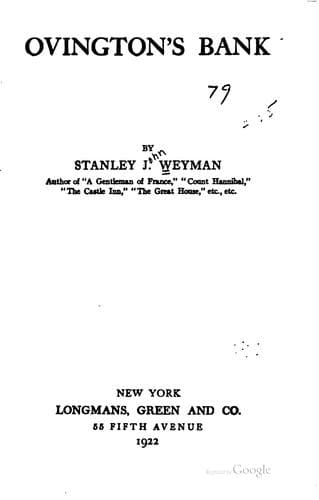
Banks and banking -- Fiction; England -- Social life and customs -- 19th century -- Fiction; Love stories
He lingered there, savoring his melancholy, until the sun went down
behind the hills, and then, attacked by the pangs of hunger, he made
his way back to the village inn. Here he satisfied his appetite on such
home-baked bread and yellow butter and nut-brown ale as are not in
these degenerate times; and for wellnigh an hour he sat brooding in the
sanded parlor surrounded by china cats and dogs—they too, would be of
value nowadays. At length with a heavy heart—for what was he to do
next?—he rode out of the yard, and crossing the bridge under the
shadowy bulk of the squat church tower, he set his horse’s head for
home. It was nearly dark.
What was he to do next? He did not know, but as he rode through the
gloom, the solemn hills falling back on either side and the dark plain
widening before him, he took courage; he began to consider, with some
return of hope, what lay before him, and how he must proceed—if he were
not to give up. Clearly he must face the Squire, but it must be in the
Squire’s own house, where the Squire must hear him. The old man might
insult him, rave at him, order him out, but before he was put out he
would speak and ask for Josina, though the roof fell. There should be
no further mistake. And he would let the Squire know, if it came to
that, that he was a man, as good as other men. By heaven he would!
He was not all hero. But there were some heroic parts about him, and he
determined that the very next morning he would ride out and would beard
the Hydra in its den, be its heads ever so many. He would win his
lady-love or perish!
By this time he was half-way home. The market traffic on the road had
ceased, the moon had not yet risen, the night lay calm and still about
him. Presently as he crossed a wet, rushy flat, one of the loneliest
parts of the way, he saw the lights of a vehicle coming towards him.
The road at that point had not been long enclosed, and a broad strip of
common still survived on either hand, so that moving on this the
horse’s hoofs made no sound save a soft plop-plop where the ground was
wettest. He could hear, therefore, while still afar off, the tramp of a
pair of horses driven at a trot, and it occurred to him that this might
be the Squire returning late. If he could have avoided the meeting he
would have done so, though it was unlikely that the Squire would
recognize him in the dark. But to turn aside would be foolish. “Hang me
if I am going to be afraid of him!” he thought. And he touched up his
horse with his heel.
Then an odd thing happened. While the carriage was still fifty yards
from him, one of the lights went out. His eyes missed it, but his brain
had barely taken in the fact when the second vanished also, as if the
vehicle had sunk into the ground. At the same moment a cry reached his
ears, followed by a clatter of hoofs on the road as if the horses were
being sharply pulled up.
Public-domain text, read in full here on John Shaqi.
Reviews
Reviews
No reviews yet
Be the first to share your thoughts on this work.
Elsewhere in the archive
Join the Discussion
Join the discussion
Sign in to leave a comment or review.
Sign InorCreate an account