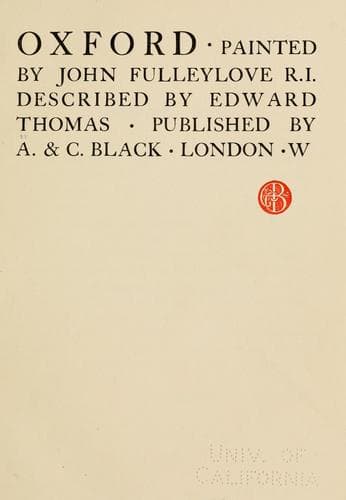
Oxford (England) -- Description and travel; University of Oxford
Those who liked not these things had at least as good an opportunity of
quiet work as to-day. A separate set of rooms for each member of a
college had gradually become almost universal in the eighteenth century;
and the great outer door or “oak” shut off those who wished from the
rest of the world. Shelley was so pleased with that impervious door that
he exclaimed: the oak “is surely the tree of knowledge!” The simplicity
of the quarters within, before much of undergraduate social life was
passed in their rooms, would astonish modern eyes, if we may judge from
contemporary cuts, that show a few chairs, a small table with central
leg, a cap and gown on the wall, an inkhorn hanging by the window, a
pair of bellows and tongs by the fire, and over the mantel-piece a
picture or mirror. But there the undergraduate was safe from duns “with
vocal heel thrice thundering at the gate,” and, let us hope, from dons,
in colleges where they came round at nine in the evening, to see that he
kept good hours. Dibdin tells us that, as he closed the _Curiosities of
Literature_, he saw the Gothic battlements outside his window “streaked
with the dapple light of morning.” Ten years later, in the first year
of the nineteenth century, Reginald Heber, then at Brasenose, looked out
from his window and saw the fellows of All Souls’ thundering the “All
Souls’ Mallard” song--
Griffin, Turkey, Bustard, Capon
Let other hungry mortalls gape on,
And on their bones with stomachs fall hard.
But let All Souls men have the Mallard.
Hough the blood of King Edward, by ye blood of King Edward,
It was a swapping, swapping mallard--
carrying torches and inspired with canary as they sang. No one appears
to have heard the song again. And with that sound old Oxford life died
away.
THE OXFORD COUNTRY
CHAPTER IX
THE OXFORD COUNTRY
_Lætissimus umbra._
And the eye travels down to Oxford’s towers.
The walls of Oxford are tufted with ivy-leaved toadflax, wallflower, and
the sunny plant which botanists call “inelegant ragwort.” They form a
trail from the villages, upon wall after wall, into Ship Street and
Queen’s Lane, by which the country may be traced. In the same way, the
city may be said to steal out into the fields. Not only do we read the
epitaph of a forgotten fellow in a quiet church, and mark a resemblance
to Merton or Lincoln in the windows of an old house in North Hinksey
Street, but the beauty of the windy Shotover plateau, with its slopes of
hyacinth and furze, and the elmy hills of Cumnor and Radbrook, are
haunted and peopled by visions of the distant spires. They give that
mild, well-sculptured country a soul. Even when the city is out of
sight, its neighbourhood is not to be put by. Everywhere it is a
suspected presence, a hidden melodist. Whether in memory or
anticipation, it is, on all our walks, “like some grave thought
threading a mighty dream.”
Public-domain text, read in full here on John Shaqi.
Reviews
Reviews
No reviews yet
Be the first to share your thoughts on this work.
Elsewhere in the archive
Join the Discussion
Join the discussion
Sign in to leave a comment or review.
Sign InorCreate an account