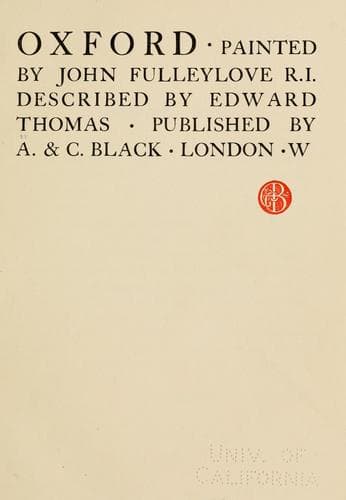
Oxford (England) -- Description and travel; University of Oxford
perhaps one of my name passed along this road. Oh! for one hour of his
joy as he spied his inn, or carved a cross in the church of St. John, or
kissed the milkmaid at yonder gateway. Or would that I could taste his
grief, even; his fresh and lively grief, I think, had something in it
which my pale soul is sick for. For me the present is made of the future
and the past. But he--perhaps--he could say, ‘Here am I with a can of
mead and a fatigue that will do honour to my lavendered sheets; _Ave
Maria!_ here’s to you all!’” Yet Philip’s mood was not seldom as clear
and simple as that.
At the inn--a classic inn to Oxford scholars--while the wind was purring
in a yew tree, he put all his gloomier fancies in a tankard, where they
were transmuted by a lambent ale and the “flaming ramparts” of that
small world. The landlord was unloading a dray. As it is with men and
clothes, remarked Philip, so with ale; the one grace of new ale is that
it will one day be old. “May I,” he said, “in some world or another, be
at least as old as this tankard, in the course of time: if I deserve it,
as old as this inn: if I can, as old as these hills, with their whiskers
of yew. Or, so long as I am not solitary, may I be as old as the sun,
which alone of all visible things has obviously reached a fine old age!”
He told me that his only valued dream was of an immemorial man, seated
on a star near the zenith; and his beard’s point swept the hilltops,
while with one hand he raised a goblet as large as the dome of the
Radcliffe to his lips, and with the other stroked his beard and caused
golden coins to flow in cascades into the countless hands of those
underneath; and in a melodious bass he said continually, “It is well.”
In his youth he had wedded Poverty, and when in the course of nature she
forsook him, he gently transferred his heart to Humility, regretting
only that he could no longer dress badly or make his own toast, without
affectation. He would give a beggar a handful of tobacco, and ask
sincerely, “Is it enough?” At the inn, he might have been lightly
treated for the respect with which he shamed the most unhappy outcast,
if he had not indifferently accepted the homage of the squire.
“Which book of the _Æneid_,” said that magnate of fifteen stone, at
seeing a Virgil in his hand, “do you like best?”
“The sixth.”
“And why?”
“Because I have just read it over again.”
“And which do you like next?”
“The second, because I read it first, and loved it (I was twelve) better
than anything but rackets.”
So he turned to the five tramps, the first I ever saw leave their hats
undoffed at his approach, who sat opposite.
Public-domain text, read in full here on John Shaqi.
Reviews
Reviews
No reviews yet
Be the first to share your thoughts on this work.
Elsewhere in the archive
Join the Discussion
Join the discussion
Sign in to leave a comment or review.
Sign InorCreate an account