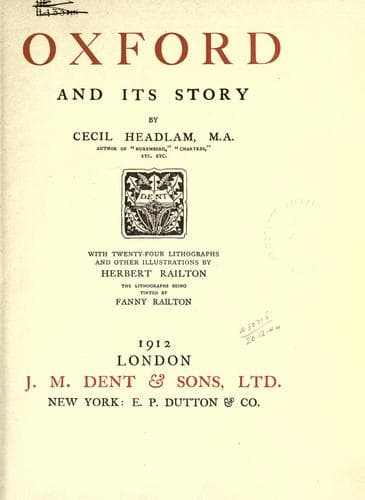
Oxford (England) -- History; University of Oxford -- History
We can supplement Chaucer's inventory of a poor student's furniture by
an examination of old indentures. Therein we find specified among the
goods of such an one just such a fithele or "gay sautrye" as Chaucer
noted, an old cithara or a broken lute, a desk, a stool, a chair, a
mattress, a coffer, a tripod table, a mortar and pestle, a sword and an
old gown. Another student might boast the possession of a hatchet, a
table "quinque pedum cum uno legge," some old wooden dishes, a pitcher
and a bowl, an iron twister, a brass pot with a broken leg, a pair of
knives, and, most prized of all, a bow and twenty arrows. Few could
boast of so many "bokes at his beddes heed" as Chaucer's clerk of
Oxenford. Manuscripts were of immense value in those days, and we need
hardly be surprised if that worthy philosopher, seeing that he had
invested his money in twenty volumes clad in black and red, had but
little gold remaining in his coffer. The books that we find mentioned in
such indentures, are those which formed the common stock of mediæval
learning, volumes of homilies, the works of Boethius, Ovid's _De remedio
amoris_ and a book of geometry. These and other books, as articles of
the highest intrinsic value, were always mentioned in detail in the last
will and testament of a dying scholar. But, as the modern artist, on his
death-bed in the Quartier Latin, summoned his dearest friend to his side
and exclaimed, "My friend, I leave you my wife and my pipe. Take care of
my pipe"; so the mediæval student would often feel that though his books
might be his most valuable legacy in some eyes, his bow and arrows, his
cap and gown or his mantle, "blodii coloris," these were the truest
pledges of affection that he could bequeath to the comrade of his heart.
Only the wealthier students, or the higher officials of the University,
rejoiced in such luxuries as a change of clothes, or could reckon among
their furniture several forms or chairs, a pair of snuffers and bellows.
For of what use to the ordinary student were candlesticks and snuffers,
when candles cost the prohibitive price of twopence a pound; or what
should he do with bellows and tongs when a stove or fire was out of the
question, save in the case of a Principal? To run about in order not to
go to bed with cold feet was the plan of the mediæval student, unless
he anticipated the advice of Mr Jorrocks and thought of ginger.
Public-domain text, read in full here on John Shaqi.
Reviews
Reviews
No reviews yet
Be the first to share your thoughts on this work.
Elsewhere in the archive
Join the Discussion
Join the discussion
Sign in to leave a comment or review.
Sign InorCreate an account